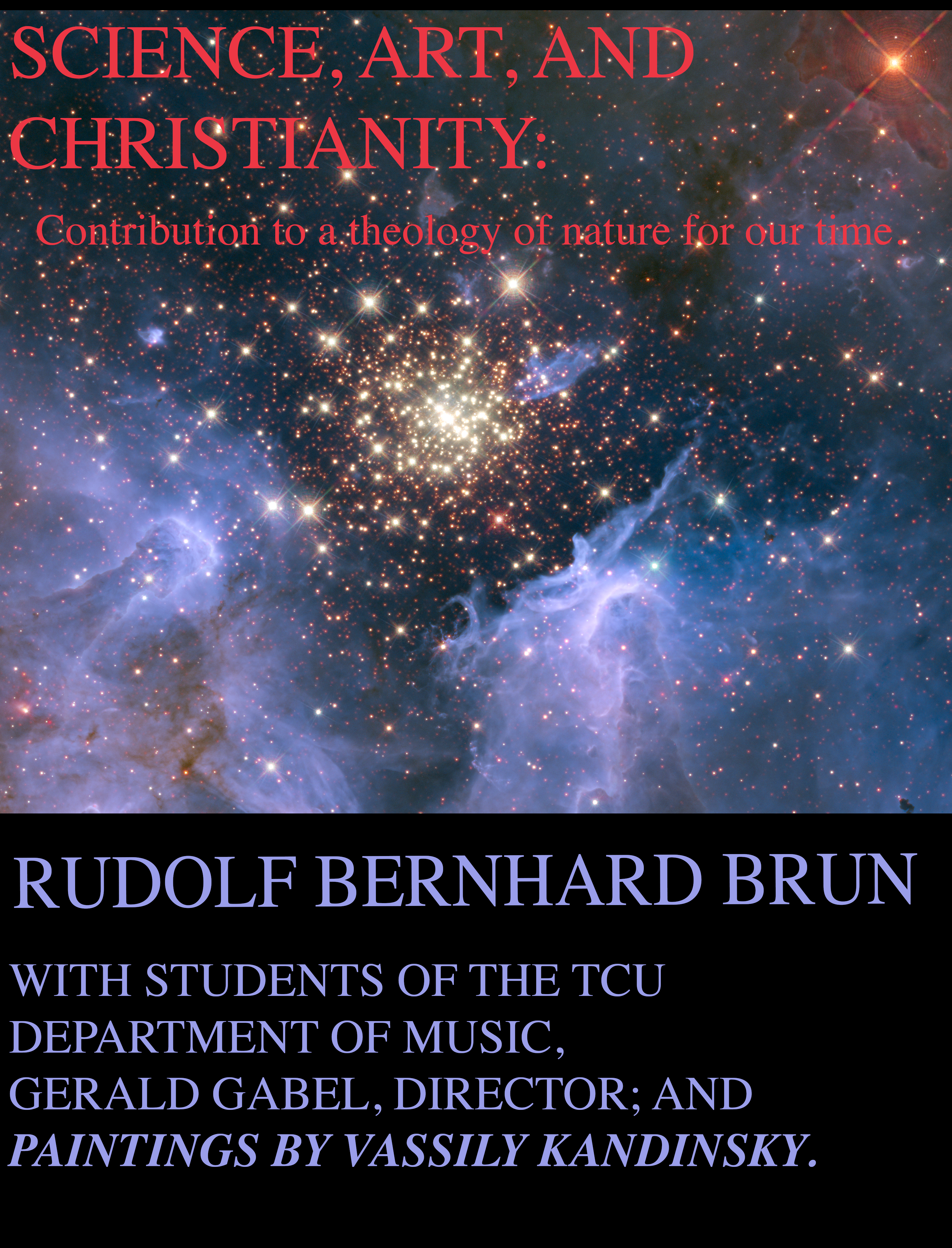
SCIENCE, ART, AND CHRISTIANITY
Sketching a theology of nature for our time.
Rudolf Bernhard Brun
I
FOR THE CHURCH
II
Copyright 2014 by Rudolf B. Brun
All rights reserved. No part of this book may be reproduced or transmitted in any form or by any media, electronic or mechanical, including photocopying, recording, or by any information storage and retrieval system, without permission in writing by the author.
ISBN 978-0-692-24578-1
III
TABLE OF CONTENTS
WHY WRITE THIS BOOK?
p. 2
CHAPTER I
NATURE IS CAPABLE OF CONSTRUCTING ITSELF
p. 11
Physical Evolution
p. 11
Biological Evolution
p. 17
Darwinism: Variation and Selection,
The Causation of Organismic Evolution
p. 20
Expanded Neo-Darwinism
p. 22
Is the post-Neo-Darwinist
Human Natural History
p. 29
The Nature of the Creative Process
p. 32
Synthesis Brings Forth a New Entity
p. 34
CHAPTER II
The Structure of Music
p. 41
The Structure of Music
p. 41
The Emergence of Polyphonic Music
p. 48
Nine Paintings by Vassily Kandinsky p. 53
p. 53
CHAPTER III
GOD AND CREATION: A VIEW FROM CHRISTIANITY
p. 67
Faith Seeking Understanding
p. 66
The Analogy of love
p. 72
God’s logic of incarnation
p. 75
Providence
p. 79
God and creation:
A glance at some other models of thought
p. 80
Pantheism
p. 81
Panentheism
p. 83
Atheism
p. 87
ADDENDUM: NATURE: Aphorism by Goethe
p. 97
REFERENCES
p. 104
CREDITS
p. 108
1
WHY WRITE THIS BOOK?
By writing this small book, I hope to contribute to the discussion of how Christianity might renew its traditional thinking about creation. At the center of this necessary effort must be the recognition of the main result of modern science; it is that that nature, from the Big Bang to us, is capable of self-construction. Any serious discussion between Christian theology and science must accept that nature is free to become itself. This is to say that there is no interference from supernatural entities into the natural creative process, no guidance, no meddling, no designing, and no pre-determined goals to reach; in short, no coercing of nature. The freedom of nature to become itself must be respected not only because the main result of modern science cannot reasonably be ignored but also because, as we will see in Chapter III, Christianity requires it. The freedom of nature to become itself must be the foundation for the bridge between science and Christianity. On the other side of this chasm, on the side of Christianity, the foundation for that bridge is already there; it is that God is
2
love, “Deus Caritas Est.”1
I’m a biologist. So why would a biologist feel the necessity to urge Christian theologians to rethink the medieval natural theology of the Church for modernity?
As I was becoming a biologist at the University of Basel, Switzerland, I had two wonderful teachers: Professor Adolf Portmann at the University of Basel, Switzerland, and the theologian Hans Urs Cardinal von Balthasar. Professor Portmann opened my mind to the mystery and beauty of animal form and appearance; Hans Urs von Balthasar trained the eyes of faith to the beauty of Christian philosophy and theology.
BothPortmann and Balthasar had a deep appreciation for the Gestalt phenomenon: that unification of diverse elements into a unified whole may bring forth not only novelty but also beauty. In their appreciation for the Gestalt phenomenon, both reflected the aesthetic/philosophical appreciation that the whole is more, quantitatively and qualitatively, than its parts. So both Balthasar and Portmann appreciated the work of J. W. von Goethe, who saw the Gestalt phenomenon as the
1 http://www.vatican.va Encyclical Letter”Deus Caritas Est”of the Supreme Pontiff Benedict XVI to the bishops, priests, and deacons, men and women, religious, and all the lay faithful “On Christian Love.”
3
foundational mystery in nature and art.2
Manyscientists experience nature to be wonderfully complex and mysterious. From where did the world, the moon, the sun, and the stars come? From where did we come? 3 The answer today is beyond doubt: humankind emerged from the same deep history of time from which everything else also came into existence. This recognition of the long history of the world does not reduce the sense of mystery. Rather, it may allow the rebirth of the romantic notion that all is connected in the same creative root, the creative source in which everything has its origin. However, significant work is yet to be accomplished. It is hardly popular to embrace the mysterious origin of all that is. Rather, “mystery” for our time is too often that, which has not yet been rationally understood; we’ll get there, if not now, then certainly later. “How will science accomplish this goal? “By dissecting that which seems to be a “mystery” into its parts; once these are understood the “mystery” is gone! To some degree it is true; at no time in history did we have such insights
2Goethe, J.W.von: “Aphorisms on Nature.” See addendum to this book. https://www.nature.com/nature/first/aphorisms.html
3Kauffman, S.: “At Home in the Universe.” : The Search for the Laws of Self-Organization and Complexity.”Oxford University Press 1995.
4
into the origin and development of nature as we have today. This is certainly due to the scientific method of analysis, of separating wholes into their parts. The mystery is, however, how parts that are integrated, united into wholes bring forth novelty; or asked differently: “Why is synthesis creative?” There will be some comments on this central phenomenon in Chapter I: “The nature of the creative process” (p.33).
AsI have already mentioned above science has established beyond reasonable doubt that nature is capable of bringing forth the entire universe through the natural process. What was once considered to be of supernatural origin, the sun, the moon, the stars, life, and mind have their common root in the creativity of nature. Modern science has rooted out the belief that natural phenomena, at least some of them, have supernatural origins. Modern physics has demonstrated that even the physical laws that organize the cosmos emerged out of the natural process; they were not designed or imposed unto nature by some “super-nature.” They are not “secondary causes” created from a supernatural “primary cause.” They are instead the result of the natural development that led to the emergence of the forces of nature such as gravity, the atomic
5
forces, and electro magnetism. There is no interference of super-nature into nature, not in the origin of the laws of nature, not in the origin of life, and above all not into the origin of the human mind. Modern science has replaced the view that, at least during critical moments, there must have been supernatural interventions into the history of nature. This interventionist understanding is dead! Modern science discovered that nature is capable of constructing itself completely.
But how you might ask? The answer is via sequential syntheses! Syntheses from what we call “matter” to life, to consciousness, all the way to the self-conscious mind of human beings. This is the great insight and foundational contribution of the work of Father Pierre Teilhard de Chardin, a Jesuit priest. He took seriously the insights of modern science that nature is capable of becoming itself. How? By sequential syntheses, by unifying that what nature had already brought forth before. 4 I believe he was right. I shall therefore follow Teilhard’s lead on the foundational importance of syntheses for the
4 Chardin, T. de: The human phenomenon” [1955] 1999. A new edition and translation of Le phénomène humain by Sarah Appleton-Weber ; with a foreword by Brian Swimme. _Sussex Academic Press.
6
construction of our world—with two modifications. First, in the realm of life I shall adhere to Darwinian rather than Lamarckian views of evolution. Second, I believe Teilhard’s rather optimistic understanding that the evolutionary process is directed towards Christ needs to be modified with a more dynamic view of the relationship between Christ and creation. Central to this relationship is the understanding that Christ, the Word of God, is given away to creation without presuppositions. Put differently, since the gift of the creative Word is given away to creation, nature can do with this gift whatever will happen naturally. It is from this creative center that belongs to creation (nature), that nature is capable of becoming itself!
In Chapter I I’ll briefly describe how modern science gained insights into how nature is capable of constructing itself. The creativity of nature, the central theme in this part, will trace the process of how “matter” became life, consciousness, and selfconsciousness in humans. Unifying the description of this process will be the Teilhardian view that throughout cosmic evolution there is one, and only one, creative principle:
7
Synthesis!
Because we know today that human beings are deeply anchored in this general evolutionary process, we recognize that our brain and its creative capacities are rooted in the same creative principle that brought forth all that is. This is the reason why we can construct models of reality and continue to expand our understanding of how nature works. While modern science is well aware of the wonderful complexity of life, there is no evidence for supernatural design, guidance, or intervention(s) at any time into the natural process of general evolution.
Call this atheism—so be it!
Chapter II offers two examples of human creativity, one from music and the second from pictorial art. These examples illustrate that human creativity, similar to the creativity of nature, is also rooted in synthesis. Synthesis, therefore, is the creative principle of creation that brought forth, and still brings forth, everything.
As to the role of the supernatural in human culture, we must acknowledge that religions are human inventions. I subscribe to the notion that: “What is God to man, that is man’s own spirit, man’s own soul; what is man’s spirit, soul, and heart – that is his God” (Ludwig Feuerbach).5 Put into the modern context of universal evolution I subscribe to the insight that: “The explanation for religious beliefs and behaviors is to be found in the way all human minds work” (Pascal Boyer). 6
This view on the origins of ceremonies, myths, and fullfledged religions must be acknowledged. Modern insights into the origins of religions as constructs of human groups for the purpose of increasing their chances of survival must be taken seriously. Of course, part of this “we-group” strategy is to get at the resources of rival groups. How so? Because religious fervor increases the combative spirit to defeat foreign groups and in this way enhance the survival of the “we-group.” We can see this throughout human history, including in the atrocities of the terrorism between religious groups today. Christianity’s perspective on the understanding that religions are the results of adaptive behaviors of human groups will be a
5 Feuerbach L. 1843: "On the Essence of Religion" In: The Essence of Christianity, second edition, Translated from the German by George Eliot Introductory essay by Barth,K. Foreword by H. Richard Niebuhr, R. 1957. New York, Harper; § 2. 6 BoyerP. 2001: “Religion Explained. The Evolutionary Origins of Religious Thought.” P.2
central topic in Chapter III.
10
CHAPTER I
NATURE IS CAPABLE OF CONSTRUCTING ITSELF
Physical Evolution
Over the last fifty years or so, scientists in various branches of physics and chemistry discovered that evolution, first found to be at work in the evolution of organisms, is also the fundamental process by which the inorganic world emerged. Nuclear physicists and astrophysicists have succeeded in describing the origin of matter in surprising detail. They discovered that the elementary particles of matter originated from energy in the primordial explosion of the “big-bang.” Energy froze into a quark-gluon plasma “in the blink of an eye.” Scientists have also identified bosons that carry the forces of nature. After about 10-35 seconds, the hypothetical single force may have split into gravity and the electronuclear force. Then, after about 10-8 seconds, the strong force that holds the atomic nuclei together split from the electro- weak force, which in turn separated into the weak force (involved in
11
radioactive decay) and the electromagnetic force (e.g. photons). About 400,000 years after the original explosion, the universe had cooled sufficiently to allow photons to be stable. The universe lit up.
The point of crucial importance here is that the forces of nature came into being through a sequence, through historical events that could have emerged in a different sequence. Universes may exist in which the forces work differently from those of our universe. What if there are zillions of universes? The important point here is that the forces of nature emerged within the historical natural process. Therefore, the laws of nature originated from within nature; they were not created or designed by super nature!
After about three minutes, the universe had cooled enough to allow the elementary particles of protons and electrons to interact with one another and settle into the new stable states of the first atoms. Hydrogen and helium (and some lithium) were the first stable elements, which originated about two minutes after the birth of the universe. 7
7 Weinberg, S. 1977: “The First Three Minutes: A Modern View of the Origin of the Universe. New York, Basic Books..
12
have found indications that the speed of the expansion of what would become our universe was several times faster than the speed of light. Somehow this inflationary expansion may have caused minute variations in the density of energy. Therefore, the phase-transition from the mottled original quark-gluon plasma into hydrogen and helium atoms might have led to an uneven distribution of these first gases. As a consequence, denser and less dense gas clouds formed. By chance, gravitational centers formed, attracting the gas located in their neighborhood. The gravitational pull of these denser areas further increased. In this way, sub galactic clumps formed, out of which galaxies might later have formed. 8
Recently, the hypothesis has arisen that galaxies might have formed through the merging of smaller, star-forming systems. Within galaxies, gas was—and still is—collapsing into stars. Stars form as a result of the gravitational collapse of matter. Rotating gases and interstellar debris fall toward a gravitational center, generating friction among the accreting matters. Toward the gravitational center the heat becomes so intense that it ignites atomic fusion. The energy generated by these
8 Elis, G. 2008: “Patchy solutions.” Nature, vol. 452, p. 158, March
13
reactions in the center of the forming star counterbalances the centripetal forces generated by the gravitational pull. An equilibrium forms between the centripetal force on the one hand and the centrifugal force generated by the energy released from nuclear fusion on the other. Thus stars do not collapse under their own weight, at least not for millions of years.
Equilibrium is maintained as long as matter exists to support atomic fusion in the stellar furnace—the fusion of hydrogen into helium, for example. But once the supply of hydrogen is exhausted, the gravitational pull becomes stronger than the centrifugal forces created by the nuclear furnace within the star. The star then collapses, generating so much friction that helium atoms start fusing, producing heavier, more complex atoms such as carbon, oxygen, neon and magnesium. When the fuel in the helium furnace is used up, the star collapses; it may become so hot that it explodes as a supernova.
At these high temperatures, protons and neutrons move so fast that they can overcome the repulsive forces within the nuclei they bombard. Neutrons and protons integrate, forming new atoms. During supernovae explosions, heavy metals, such as mercury, silver, and gold are synthesized in this way. When
14
the star explodes, its materials, including these heavy elements, are spewed out as an interstellar cloud of gas and dust. From such clouds, new suns with planetary systems emerge. Our solar system formed from such a cloud. A myriad of solar systems are scattered across the entire universe, some with planets resembling Earth 9
In this way the heavier elements listed in the periodic table were synthesized from the lighter ones. The static representation of atoms listed in periodic table, however, is quite misleading. This because the history how they originated is missing. Various elements were (and still are) generated sequentially through synthetic processes. The synthesis of previously created elements into new entities under appropriate environmental conditions was (and still is) the mechanism that has led to increasingly new complex entities.
Protons and neutrons, the components of atomic nuclei, are formed from the merging of quarks, elementary particles that are older than the protons and neutrons they form. Protons and neutrons emerged through integration of these elementary particles. Synthesis generated new entities with totally new
9 Borucki, W. et al. 2013: “Kepler-62: A Five-Planet System with Planets of 1.4 and 1.6 Earth Radii in the Habitable Zone.” Science 3 May: pp. 587-590.
15
properties: protons and neutrons can form atomic nuclei but quarks by themselves cannot.
Once protons and neutrons are formed, they can become fused into the atoms listed in the periodic table. Each synthetic step creates a new entity with new properties. This synthesis results in a new and unique atom. This synthetic process that brings forth atomic evolution is nonlinear. Physical evolution is nonlinear because the properties of the whole are radically different from the properties of their parts.
Once Interestingly, the various species of atoms are separated from one another by leaps. For example, no stable intermediates exist between hydrogen and helium, nitrogen and oxygen. Leaps occur again when atoms interact with one another to form the next order of complexity, the molecules. If oxygen and hydrogen are simply mixed together, both components remain gases. Under appropriate conditions, however, the elements interact to form water. Again, no stable intermediates exist between oxygen and hydrogen gases and water molecules. But once the reaction starts, the mixture becomes unstable and within less than a picosecond (10- 12 seconds) passes into a new, stable state: water. Again, the process of synthesis of water
16
from hydrogen and oxygen is nonlinear. Thus, water is liquid at temperatures at which its components are gases.
Biological Evolution
Chemistry demonstrates that the generation of new molecules by synthesis from already formed molecules is practically without limits. The chemical processes that occurred during the history of our planet led to the formation of increasingly complex molecules, ultimately resulting in the synthesis of self-replicating molecules.
These self-replicating molecules, most likely RNA, probably became encapsulated into vesicles. Researchers have recently described bilayered vesicles (miscelles) that can catalyze their own replication The integration of information containing molecules such as RNA into miscelles might well have been a crucial step in the origin of life. 10
While the details of how life originated need to be firmly established, life clearly emerged as a result of chemical evolution. The emergence of life on earth is the result not of
10 Chen I.. and Walde P. 2010: From Self-Assembled Vesicles to Protocells. Cold Spring Harbor, Perspectives in Biology, Published in Advance June 2 , doi: 10.1101/cshperspect.a002170
17
supernatural intervention but of the universal creative process of general evolution. The emergence of life is therefore not an extraordinary event in this process but an expected one. In this view, life is a probable outcome of increasing chemical complexity; wherever energy is available and circumstances are favorable, life will emerge.
After early Earth had cooled enough that water could remain liquid, it took only about 500 million years for life to form. Compared to the billions of years necessary to form our solar system from the big-bang explosion, 500 million years is comparatively short. We must conclude that the emergence of life is easy. On Earth, it took only about 500 million years for life to emerge. Compared to the four and a half billion years it took the solar system to get organized this is very fast and must therefore be easy.
In contrast to this relatively short time for life to form, the first eukaryotic cells (cells with a nucleus) required about 1,000 million years to emerge. It is now well established that algae formed in a multi-step process by intracellular symbiosis.11 Once eukaryotic cells formed, organic evolution
11 Gould, S. 2012: “Algae’s complex origins.” Nature, vol. 492, p. 46.
18
continued through differentiation of cells followed by the integration of cellular diversity into new unified, that is, holistic constructions.
One important question in this context is: Why did some forms of life become increasingly complex while others did not? Bacteria today, for example, may well exist at a level of complexity that they had reached two billion years ago. We have no answer to this question because we cannot construct a probabilistic network of evolutionary roads. We have no way to design history because we are utterly unable to reduce chance events to events determined in advance. Chance will statistically influence circumstances that exist at any given moment, but not deterministically. Why some forms of life get stuck at dead ends while others evolve to increasing complex forms of life (or die out entirely) depends on how chance events are involved. Evolutionary history, opportunities grasped or missed, are essential factors in the entire process.
In contrast to this relatively short time for life to form, the first eukaryotic cells (cells with a nucleus) required about 1,000 million years to emerge. It is now well established that algae formed in a multi-step process by intracellular symbiosis.11 Once eukaryotic cells formed, organic evolution
19
Darwinism: Variation and Selection, the Causation of Organismic Evolution
Charles Darwin’s great discovery was that evolution works because individuals in a species of organisms are different and selection favors those better adapted. Darwin writes:
“If under changing conditions of life organic beings present individual differences in almost every part of their structure, and this cannot be disputed; if there be, owing to their geometrical rate of increase, a severe struggle for life at some age, season or year, and this certainly cannot be disputed; then, considering the infinite complexity of relations of all organic beings to each other and to their conditions of life, causing an infinite diversity in structure, constitution, and habits, to be advantageous to them, it would be a most extraordinary fact if no variations had ever occurred useful to each being’s own welfare, in the same manner as so many variations have occurred useful to man. But if variations useful to any organic being ever do occur, assuredly individuals thus characterized will have the best chance of being preserved in the struggle for life; and from the strong principle of inheritance, these will tend to produce offspring similarly characterized. This
20
principle of preservation, or survival of the fittest, I have called "Natural Selection.ˮ 12
No science of genetics existed in 1859 when Darwin published his famous work, The Origin of Species. Scientists had proposed theories trying to explain the causes of variations. Darwin himself had quite an elaborate explanation of how such differences could arise, based on an old conviction that the contents of the parents’ body fluids were transmitted to the offspring. He proposed that the body fluids were a vehicle to transfer parental characteristics to the next generation. He believed that parental traits, including characteristics that they had acquired during their lifetime, could be beneficial to the next generation. Darwin suggested that the inheritance of acquired characteristics was the cause for variations among individuals of the same species.
With the rediscovery of Mendel’s work at the turn of the century, the emerging science of genetics disproved the Lamarckian/Darwinian notion of the inheritance of acquired characteristics. Instead, it became clear that variation among
12 Darwin, Ch. [1859] 1902: “The Origin of Species by means of natural selection or the preservation of favoured races in the struggle for life.” Sixth edition, Edinburgh Press, , pp. 159–160.
21
organisms resulted from their different genetic makeup. In addition, the crucial discovery was made that germ cells (eggs and sperm) and the other cells of the body (the soma) could not exchange genetic information with one another. It was therefore impossible that acquired characteristics could change the genetic makeup of the germ cells. Characteristics acquired by the parents could not be passed on to the next generation. These new insights led to an improved understanding of the nature of variation. A significant step had been taken from Darwinism to Neo-Darwinism.
In essence, the Neo-Darwinist view holds that organic evolution works by selection acting on the variation of individuals (phenotypes) caused by randomly mutating genes. Today we know that the natural process that brings forth new species of organisms is however much more complex.
Expanded Neo-Darwinism
In 1972 Niles Eldredge and Stephen Jay Gould published a paper entitled “Punctuated Equilibria: An Alternative to
22
Phyletic Gradualism.” 13 In this paper the authors argue that “speciation is a rare and difficult event that punctuates a system in homeostatic equilibrium.” The paper is of crucial importance because it documents punctuated evolution in the fossil record of some mollusks. Long periods of stasis (millions of years) are interrupted by spurts of emerging innovations (tens to hundreds of thousands of years).14 This view is significantly different from the NeoDarwinistic understanding of evolution as an essentially gradual process.
For other reasons the notion that organic evolution can be explained by “randomly muting genes and natural selection” must be modified. One reason is that the information provided by “genes” does not translate into the morphology or function of an organism. Rather, the information provided by genes only partially controls the construction of organisms.
Another essential level of control is how the information transmitted by genes is used. Gene products, (e.g., messenger
13 Eldredge, N., and Gould, S. 1972: “Punctuated Equilibria: An Alternative to Phyletic Gradualism.” In Models in Palaeobiology. San Francisco: Freeman, Cooper and Co., 1972, pp. 82–115.
14 Gould Steven J.: “Is a New and General Theory of Evolution Emerging?” Palaeobiology, vol. 6 (1), 1980, p. 129.
23
RNAs) are usually processed. They become edited by first splitting the transcripts of DNA into smaller pieces that then become spliced together with parts from other genes. Some DNA transcripts become rapidly degraded and will not be used at all. Perhaps the most important point is that there is no linear translation of genes into an organism. Put differently, an organism is not somehow preformed at the genetic level. “Randomly mutating genes” will not necessarily produce different phenotypes. Rather, genetic information is edited by tailoring, cutting, and splicing before it is used. So one “gene” might contribute to a variety of functions, including regulating other genes. This why it is difficult to define what a gene really is- it is a snippet of information that can be used in multiple ways.
The DNA of an organism and how the information it contains is used is enormously complex. Mutating genes are certainly a part of the evolutionary story, the changing patterns of how the expression of genes are controlled is another essential part. Gene expression is controlled along many levels. Ultimately, all these levels must be studied together to obtain a complete picture of how these various patterns of gene
24
regulation and their control mechanisms evolved.15 How these control mechanisms interact with one another and how they are involved in bringing about new forms of life is overwhelmingly complex. Yet in a population of organisms, changes in this complex system must occur quite frequently. As the environment changes over time, some alterations at any level of gene expression control might be advantageous, especially if environmental changes exert stress on a population.
Experiments performed with yeast cells show that under stress, the number of chromosomes may change, which produces large-effect mutations. Such mutations might lead to significantly altered genomes as compared to the original gene combination. One or several of such new genomes might cope more effectively with the new environment (e.g. stress).16 Such surprisingly “rapid” generation of new genomes (and their regulation mechanisms) might contribute to a better understanding of Eldredge and Gould’s finding that evolution
15 Kevin. K. and Rajewsky, N. 2007: “The evolution of gene regulation by transcription factors and microRNAs.” Nature Reviews Genetics, vol. 8, pp. 93–103.
16 Chen G. et al. 2012: “Hsp90 stress potentiates rapid cellular adaptation through induction of aneuploidy.” Nature, vol. 482, p. 246, 2012. 129.
25
of new forms of life is not necessarily gradual over long times as Darwin had suggested (hundreds of millions of years) but also may occur in in spurts over relatively short episodes (millions of years). Biologists do not claim to fully understand the complexity of organismic evolution. What biologists have discovered in the wake of Darwin, however, is that the evolution of new species of organisms, including human beings, is a natural process, not designed, goal-oriented, or otherwise controlled by any supernatural agency.
Is the post-Neo-Darwinist view of evolution, materialistic?
Over the years a number of sources have asserted that Darwinism in any of its variations is materialism. This view of Darwinism is based on at least four aspects. First, Darwinism is considered materialistic because it claims to make any variety of supernatural interventions into the processes that bring forth new life forms unnecessary. Darwinism claims that the twostep process of individual variations within species of organisms and natural selection is sufficient to bring forth new species. Second, Darwinism is seen as materialistic because organic evolution does not require any type of vital force to
26
drive the process; it can therefore be understood as the outcome of chemico-physical forces that obey only natural law. Third, Darwinism has been seen as materialistic because it negates teleology: Evolution is not launched towards any predetermined goal, (e.g. the evolution of human beings). Rather, Darwinism insists that the only force directing evolution is chance followed by natural/sexual selection. Fourth, and this is perhaps the most fundamental objection to Darwinisim: “Matter cannot produce mind.”
Scientific research has easily disproved the first two objections to Darwinism Evolution does not require any supernatural intervention, neither for the emergence of life nor for the appearance of human beings. Science also showed that there is no need for any vital force that would control the development of embryos to adults: Vitalism is dead!
Furthermore, science cannot find any evidence that evolution executes a plan or works toward a predetermined goal. Quite to the contrary, science makes the point that evolution is a genuine historical process, essentially probabilistic, openended and therefore unpredictable. Darwinian theory posits that organic evolution is the outcome of a two-step process
27
driven by mutations and selection by chance and necessity. 17 Ernst Mayr, one of the pillars of Neo-Darwinism, writes: “Over the generations this process of natural selection will lead to a continuing gradual change of populations, that is, to the evolution and production of new species.” 18 Because changes in the environment are unpredictable, especially over millions of years, there is no way to predict how organisms will have to adapt to such new circumstances of life. Because of this essentially statistical, probabilistic nature of the evolutionary process it is impossible that such a process is goal-oriented. Evolution happens in an open, undetermined future. Therefore, it cannot be teleological, but is necessarily probabilistic, historical and therefore unpredictable.
The question then becomes: Why is it that complexity in the universe has increased, from the first elementary particles, to life, to organisms, and finally to the incredible complexity of human beings? What is the evolutionary history that leads from our ancestors to us?
17 Monod, J. 1971: “Chance and Necessity. An essay on the natural philosophy of modern biology.” New York, Random House 1971.
18 Mayr, E. 1982,: “The Growth of Biological Thought. Diversity, Evolution, and Inheritance.” Cambridge, MA: The Belknap Press, p. 480.
28
Is the post-Neo-Darwinist view of Human Natural History
When we look at our body, feet, knees, legs, abdomen, shoulders, neck, and head we might well wonder, why are we put together this way? One answer to this question might come from paleontology, the science that investigates the evolutionary history of organisms: We are built this way because we inherited the architecture of our body from our evolutionary ancestors. However, now most scientists accept the concept that our most recent ancestors, those humans who lived about two hundred thousand years ago, looked just the way we do. In humans who lived farther back in time, however—perhaps about three hundred thousand years ago— paleontologists start to detect differences. The fossils of those earlier human skulls show thick, protruding brow ridges. In addition, unlike later human skulls, which are shaped like volleyballs, these earlier skulls were shaped like footballs (Balter 2002). 19
Because skulls package the brain, fossil skulls are the most valuable indicators of what happened in our evolutionary history, brain size increased! The average size of a modern
19 Balter, M. 2002: “What made humans modern?” Science, Vol. 295, pp. 1219–1225.
29
human’s brain is between 1,300 and 1,400 cubic centimeters (cm3). Earlier humans, such as Homo heidelbergensis, who lived about one million years ago, had brains of only about 1,000 to 1,300 cm3 .
The question arises. What evolutionary mechanisms are capable of generating bigger brains? The biological answer to this question is clear: natural selection. Among a population of individuals with various brain sizes, individuals who possess bigger brains might be smarter than the ones with smaller brains.20 Over time smarter individuals will most probably accumulate more and better resources. Over time, therefore, the entire population will better adapt because the frequency of smarter individuals in the population will increase through individual variation and natural selection. 21 This two-step mechanism is creative!
Our bodies share their basic architecture with so many other vertebrates. We have feet, knees, legs, abdomen, shoulders, neck, and a head because we share the genetic programs that build us this way with countless relatives, both close and
20 Gibbons, A. 2013: “Stunning Skull Gives a Fresh Portrait of Early Humans.” SCIENCE, vol. 342, pp. 297/298.
21 Lordkipanidze, D. et al. 2013: “A Complete Skull from Dmanisi, Georgia, and the Evolutionary Biology of Early Homo.” SCIENCE vol. 342, pp 326-331.
30
distant. If this is so, why are we so different, so much more conscious and intelligent than any other form of life?
The size of the brain alone is not enough to account for intelligence, consciousness and self-consciousness. In addition to the size of the human brain, the complex brain architecture, organization into modules and connections must be considered. Also, the complexity of the synaptic junctions between neurons is crucial for its proper function. It is from this hierarchy of enormous complexity that mind and self-awareness emerge. Though scientists may acknowledge that we may never fully understand the origin of self-consciousness it is by now an obvious fact that our mind emerges from the complexity of our brain. Mind is not alien to “matter.” Rather, the brain is the organ that brings forth our mind. Both, consciousness, and selfconsciousness are emergent properties. They are rooted in the complexity of the structure and function of our brain. Consciousness, and self-consciousness are novelties that came into existence through the unification of mental structures that emerged in a historical sequence of syntheses. Mind is no exception from everything else brought forth by the universal creative process. The synthesis of novelty from parts that were
31
synthesized before is the creative source from which everything came and still comes into existence. In other words synthesis is the ontological source of all that exists; “matter”, life, consciousness, and self-consciousness. The common root of these different ontological levels of reality is the Gestalt phenomenon, the phenomenon that united unities have properties that their individual parts do not have. In the case of our brain, it is also anchored in this basic ontological architecture of the entire universe. It is thanks to this fundamental congruence of the architecture of our mind with the architecture of the entire universe that the world is open to our mind. This is the positive side of our common root with all reality; the negative aspect is that our understanding of the world is limited by the constraints of space and time. In short, we can experience the world only through our brain, the body of our mind.
Is the post-Neo-Darwinist view of The Nature of the Creative Process
Clearly, our brain determines who we are. Unfortunately, we can only appreciate the complexity of normal brain function when these functions start to fail, as in people with mental
32
diseases, schizophrenia, Parkinson’s, Alzheimer’s, and such. Diseases that disrupt normal brain function change who we are, robbing us of our personality. Put negatively, it is the corruption of (brain) “matter” that robs the mind! Or positively, mind emerges from the correct functioning of the brain. No reasonable doubt exists anymore that our brains emerged through the same evolutionary process that generated the minds of animals, including the ones of social animals.22 How did this amazingly complex organ come into existence? If someone insists, as I do, that consciousness, mind, and even self-consciousness result from the natural process of evolution, how did they evolve from “matter”?
In my opinion, philosophers have tried to explain brain complexity in two ways. One approach is to say that mind (spirit) is already in “matter.” As “matter” gets increasingly complex, what already exists in “matter” potentially comes into actual existence. This understanding puts spirit into matter from the beginning so that spirit—the total opposite of “matter”—may appear.
20 Gibbons, A. 2013: “Stunning Skull Gives a Fresh Portrait of Early Humans.” SCIENCE, vol. 342, pp. 297/298.
22 Portmann, A. 2013: “A Zoologist Looks at Humankind.“ Trans. by Judith Schaefer. New York City: Columbia University Press.
33
Others propose that as matter evolved a supernatural agent implanted spirit “from above” into matter that came “from below.” In fact, no essential difference distinguishes these two views; in both cases mind is in its essence different from matter. The only difference lies in how spirit came to imbue matter. For the first view, spirit is potentially within matter from the beginning; in the second understanding, spirit somehow connects with matter later. I posit moving away from this dualistic view of the mutually exclusive “essence” of matter and the “essence” of mind. This is because both proposals of how mind came into matter do not appreciate the phenomenon of emergence, the phenomenon that synthesis of parts into unity brings forth novelty, novelty with qualities that the individual parts do not posses.
Is the post-Neo-Darwinist view of Synthesis Brings Forth a New Entity
Science has made enormous progress both in establishing the parameters that favor the occurrence of synthesis and in describing the sequential steps through which synthesis happens. The entity that emerges through synthesis has properties that the components from which synthesis began do
34
not have. This phenomenon is at the center of chemistry. Yet throughout atomic and molecular evolution, the unification of elements also leads to the emergence of new wholes. The central phenomenon of chemistry is by no means restricted to this branch of science, it is everywhere! The synthesis of parts into new unities with radically new properties is the central phenomenon in nature; it is the phenomenon of emergence, the basic creative principle that wholes have qualities that their parts do not have.
Philosophers in east and west have long recognized the phenomenon. For example, the Greek philosopher Plotinus
writes:
“It is in virtue of unity that beings are beings. This is equally true of things whose existence is primal and of all that are in any degree to be numbered among beings. What could exist at all except as one thing? Deprived of unity, a thing ceases to be what it is called: no army unless as a unity: a chorus, a flock, must be one thing. Even house and ship demand unity, one house, one ship; unity gone, neither remains. Thus even continuous magnitudes could not exist without an inherent unity; break them apart and their very being is altered in the measure
35
of the breach of unity.” 23
This essay is not the place to trace this fundamental insight into the nature of reality through the history of philosophy. Suffice it to say that this theme provides the baseline for the poetic and scientific work of Goethe, for example. A holistic understanding in philosophy/psychology resurfaces in the works of Christian von Ehrenfels, Wolfgang Koehler, Max Wertheimer; in biology by Lloyd Morgan, Jan Smuts, and Karl Popper, to name a few. More recently, a number of mathematicians, physicists, chemists, biologists, psychologists, and philosophers of science, proposed that complexity is not a linear extrapolation of the individual qualities of their parts. Rather, although complex systems do emerge from the integration of their parts, those complex systems nevertheless have qualities that their elements in isolation do not have. This phenomenon is precisely the one that philosophers of old had already clearly seen, appreciated, and described. The modern science of complexity proposes that through synthesis/emergence, the whole is greater than the sum of its
23 [Plotinus [ca. A.D. 204–270] 1929 MacKenna, tr. p. 614. Classical Review 1929.
36
parts both quantitatively and qualitatively!
The phenomenon of emergence is of deep interest for quite a few contemporary philosophers and scientists (e.g., Morowitz, 2002; Peterson, 2006; Bickhard, 2009). The question becomes whether the phenomenon of emergence can be explained by science. “Explain,” in this case, would mean to understand creativity—why it is that the unification of less complex entities brings forth a new more complex entity; a new level of ontological reality.
The history of emergent properties, involves the development of increasing complexity in those lines of life where local circumstances were favorable for such synthetic events to happen. Such events also include the synthetic events that led to the emergence of the human brain. What we call mind is something that came, not from somewhere outside the evolutionary process, but from within. As a consequence, who we are is essentially an emergent property of our brain (i.e., our individual brain generates our individual personality). Put differently, our brain is the body of our mind. The brain emerged from the integration of parts that nature had already put together. As C. G. Jung states, “Thinking existed long
37
before man was able to say: I am conscious of thinking.”24The archetypes Jung discovered and described might serve as an example of the importance of unification of psychic entities. “The personality of the ‘I’ depends on the integration of the entire psychic structure.”25 Mind therefore emerges as the tip of a pyramid supported by elements that had been synthesized earlier in the creative process. This understanding of selfconsciousness emphasizes the centrality of synthesis. The unification of pre-existing psychic structures leads to the emergence of the “the personality of the ‘I.’” Selfconsciousness is a Gestalt phenomenon like all the creative events that brought forth, and still bring forth, the past and future of nature.
In what follows I’d like to show that human creativity in music and art is analogous to the creativity of nature because it also works by historical, sequential synytheses.
24 Jung, C. G. [1939], 1968: “The Archetypes and the Collective Unconsciousness.” The Collected Works of C. G. Jung, Volume 9, part 1. Bollingen series XX. Second edition, Princeton, NJ: Princeton University
Press, p. 280. 25 Ibid: p. 289.
CHAPTER II
“Great Art Picks Up Where Nature Ends.”
(Marc Chagall). 26
As I have tried to show in Chapter I, the constructs of nature emerge from sequential syntheses; parts that were previously synthesized may become elements for the next synthetic step. As a consequence of this universal mode of bringing forth novelties, the constructs of nature are always unities of elements that are unities of elements themselves. This is why all constructs of nature (except perhaps the elementary particles) are hierarchies: there are entities at lower and higher levels in all things of nature. That is why all constructions of nature are hierarchically organized (see Chapter I). The purpose of Chapter II is to suggest that our mind is capable of creating art because art emerges from synthesis, the same creative source that brought forth all of nature, including our brain.
I propose two examples to make my case, one from the history of Western music and one from the pictorial arts, from
26 Chagall, M. https://www.brainyquote.com/authors/marc-chagall-quotes
a sequence of paintings by Vassily Kandinsky. These two examples will also demonstrate two principles that are also essential to the constructions of nature. The first is that complexity in nature and art can increase historically, that is without teleology, purpose, or design. The second is to show that “morphogenesis happens at the edge of chaos,” as Stuart Kauffman puts it.27This is to say that new styles of painting, for example, may defy tradition, liberating the old language of form, shape, and color from the frozen style of the past. This way, the freed pictorial elements of former styles become available for new ways of expressing inner visions to the outside.
In my view, the art of Vassily Kandinsky is an example of this process. A first phase leads to the deconstruction of an old style. This brings forth a new space in which the liberated elements may interact with one another in a musical pictorial language never heard or seen before. It is in this language that
27 Kauffman, S. 1993: “The Origins of Order: Self-Organization and Selection in Evolution.” New York, Oxford, Oxford University Press, pp 30/31.
40
Kandinsky expresses his heart-felt poetry on the canvasses of his late work. 28
Is the post-Neo-Darwinist view of The Structure of Music
In Chapter I wrote about the Gestalt phenomenon, namely that a genuine unity of parts has qualities that the separated elements by themselves do not have. In short, wholes are more than their parts not only in quantity but also in quality (p. 21f). Therefore, if nature is capable of unifying parts into wholes then these new wholes are essentially different from their parts. This is to say that synthesis brings forth novelty; synthesis is creative. We are perhaps most familiar with the power of synthesis in chemistry. There, the chemical integration of molecules brings forth new compounds with peculiarities totally different from the properties of the their molecular parts used for the synthesis.
As I have already discussed in Chapter I the phenomenon of emergent properties applies not only to chemistry but also to physics, for example to the synthesis of atoms at the center of
28 Perhaps it is the case that the genetic elements involved in organismic construction also may go through chaotic phases that make them available for the emergence of totally new forms of life.
41
the stars. It also applies the origin of life, a phenomenon that emerged from the synthesis of pre-life molecules.
These molecules are the result of increasing complexity that led from protons, neutrons, and electrons to atoms, to chemical compounds in space and on the forming Earth, from there to the complex molecules from which life emerged. This increase in complexity is a consequence of sequential syntheses, a process that necessarily increases complexity because it always integrates into the new the parts that were already synthesized previously. This process of increasing complexity generates an architecture that is common to all complexity. This because each synthetic step generates novelty that always is anchored in its parts that were previously integrated.
The energy necessary for each synthetic step must be available locally, but it ultimately originated from the energy released in the big bang explosion. What may become synthesized is also dependent on local circumstances, on the local interaction of parameters such as the distribution, variety, quantity, and density of materials that can be integrated. In other words, synthetic events are deeply statistical in nature; synthetic events are therefore historical events in the history of
42
the creative, natural process. This history generates the parameters defining local circumstances at any time throughout the creative process. Because of this historical nature of the creative process future events can only be predicted statistically. As time moves on what actually will happen can therefore only be expected with probabilities not certainties. Because of this probabilistic nature of the creative process it cannot reach a pre-determined goal; the process cannot be teleological.
What does this have to do with the structure of music?
At its root, music emerges from the creative source that brings forth everything: the Gestalt phenomenon. Listening to music, therefore, allows us to experience the creative principle that is the source of all that is. Listening to music is experiencing the Gestalt phenomenon, the central phenomenon from which the stars, the sun, the moon and the beauty of the entire universe emerged. As I have just tried to explain, the complexity of the universe increased historically and locally where it was possible. I suggest that there is an analogy between the increasing complexity in nature and in musical compositions: in both sequential integration of what was
43
integrated before results in increasing complexity. Of course, the elements of construction are different; in nature the synthesis starts from that we call “matter,” whereas in music the basic elements are rhythms and notes. In composing music, the composer integrates these basic elements into new and more complex structures, such as melodies; he or she may then combine these into movements of symphonies. Both melodies and symphonic movements emerge as hierarchical constructs built of simpler parts that are, however, already complex themselves.
Let’s start with a note; a B-flat or a C-major played on any instrument, for instance, seems to be simple. Yet the same note played on different instruments—a clarinet, a trumpet or a violin—sounds very different, because each instrument has its characteristic sound in playing a musical note—its specific timbre. Timbre is that quality of sensation by which a listener can judge that two sounds sharing the same volume and pitch are nevertheless different. This difference depends primarily upon the spectrum of the stimulus and upon the waveform, the sound pressure, the frequency location of the spectrum, and the temporal characteristics of the stimulus. In addition, the
44
fundamental frequency of sound becomes modified by the harmonics and overtones that are peculiar to a particular instrument.
A simple note played, for example, by a violinist is a quite complex unity of different parameters. But even more, the violinist’s technique in applying the bow to the strings, the softness or pressure of touch, will give a specific quality to each note played. And of course, how the vibrating strings excite the resonance of the body of the instrument will be crucial for the quality of the sound. The way the body of the violin resonates depends on how the violin was built—what kind of wood the violinmaker chose, how he or she treated the wood, what mixtures of varnishes, paints and resins he or she used. As a result, the sounds produced by different violins will be quite distinct even if the same note is played. The reason is that a simple sound or note is in reality quite complex.
Yet this very complexity may be a simple element that could serve to build greater complexity. Imagine the beginning of a performance by an orchestra; with the principal oboist playing the A note to which all other instruments will adjust their pitch. Then hear the woodwinds, the violins, the celli, the basses and
45
the brass all playing the same “simple” note—yet what an immense complexity!
Still, this complexity may become integrated into the recognizable simple sound of a good orchestra. The New York Philharmonic, the Cleveland Symphony, and the Boston Pops all sound different. But each possesses the simple characteristic sound that emerges from a mind-boggling complexity. And this unity of sound becomes the simple element that serves to construct the complexity of the first few notes of a piece of music. An orchestra may have perhaps a hundred or more instruments, all engaged in playing the first melody of a symphonic movement. The melody itself might be of an attractive simplicity. Yet this simplicity is but an element of an unfolding sequence of melodies, each serving as a simple element in the construction of an entire symphonic movement; and the various movements are the simpler elements that become integrated into the unified complexity of an entire symphony.
To listen to music is to dwell within its dynamic architecture, to experience the dynamic construct that builds itself up from the integrated diversity of rhythm, sounds and melodies. The
46
architecture of a piece of music therefore consists of a hierarchy of simpler elements that are already hierarchies of still simpler elements themselves. Yet a good piece of music integrates all these elements so effectively that they become subservient to the overall unity of the entire piece.
The musical experience of a Mozart symphony is pure and crisp, of sublime simplicity. Yet this wonderfully rich simplicity is of course highly complex. It is a simplicity that emerges from ultimately complex sophistication; it is simultaneously simple and complex. From this perspective, the dynamic architecture of music is at the same time simple and complex; its architecture is simplex!
The fundamental similarity between the architecture of music and the architecture of nature is this: both are hierarchical constructions that come into existence through the integration of parts that are hierarchical constructions of parts themselves. Deconstructing these two different types of hierarchies, the hierarchies of music and the hierarchies of natural objects, reveals that from the highest to the lowest level of these two types of hierarchies all parts consist of elements that are already complex hierarchies of integrated elements themselves.
47
The reason is that both hierarchies emerge from sequential syntheses.
Viewed from top down, the elements that construct these hierarchies appear to be simple. Yet they are really complex; they are both simple and complex. The conclusion is that the constructs of nature and the architecture of musical compositions are both simplex. An example from the history of Western music demonstrates how the synthesis of previously synthesized parts may lead to new styles of simplexity.
The Emergence of Polyphonic Music
Although the Greeks discovered chords, they probably did not use them in their musical constructions. Their compositions were probably rather similar to Eastern music, in which music is strictly linear without the vertical components of chords. This serial construction follows strict rules that allow dynamic unity to emerge from integrated linearity. So although the melodic elements are linearly sequenced, these elements interact to form a dynamic whole.
As far as we know, the music of the West during the early Middle Ages was also exclusively serially constructed. For
48
example, Gregorian chant sung in support of church services was linear; i.e., without any vertical (harmonic) components.
Over the next 650 years these single-line Gregorian chants gradually became more complex. Surprisingly, this process of increasing complexity in the music from the Middle Ages to the music of the Baroque era resembles the process of increasing complexity of genomes during organismic evolution. In both processes complexity increased through duplication, diversification and integration. A gradual process of increasing complexity in both music and genome structure generates new entities through historical—not predetermined—events.
At the start of the process, duplication generates a second, at first identical, sequence. This new duplicated line differentiates itself from the original line through mutations in genomes, and through variations the composer creates in the melody, which at first was identical with the original line. Both lines are related to one another because of origin yet become increasingly different through time. In spite of becoming different, the musical parts of the original and the newly composed line still resemble each other. This musical
49
differentiation is analogous to the differentiation in the modules that make up the original and the duplicated genetic entities.
In a third step, these modules start interacting with one another—in music because of chords that emerge from simultaneously performed musical phrases (modules), in genetics though mutations that allow interactions between at first isolated original and derived modules. In both cases a new element is synthesized through the integration of the newly generated parts.
In music, a vertical, harmonic structure that produced consonances and dissonances arose. Since we have a strong inborn natural desire to release the musical tensions of a dissonance into a consonance, a new, crucial vertical principle that served horizontal developments of the music was discovered. Music continued to become more complex through at least two different pathways: repetition of the already described three-step process and the chronological shifting of modules (i.e. letting duplicated melodic lines start at different times from the original one). Such shifting of modules leads to a canon, in which the synchronous interaction of the melodic
50
modules is replaced by sequential, asynchronous interactions. From modern molecular genetics we know that such module shifting also generated new programs that brought about new ways for embryos to develop.
Part I: The first part of the history of polyphonic music starts with an example of a single-line Gregorian chant. It continues by the addition of an exactly duplicated line, sung together with the original line at the distance of an octave, fifth or fourth. Later composers found that this strict parallelism was not really necessary, that the duplicated lines could be different from—yet related to—the original one. Composers also discovered that the second line could differ rhythmically from the original melody.
The first part of the musical examples ends with an example of such a composition.
Part II: Part II illustrates how composers added new melodic lines to the original line. This new composition was different
51
from the original line, yet compatible with it. Although the new line was composed, the composer created this new line in such a way that it was related to the primary line. This is a good example of how new elements emerge through the integration of diversity into uniformity. The connection between the musical phrases of the original musical line and the phrases of the newly composed line maintained the unity of the entire piece through the connection of diverse parts.
During the Renaissance, musical complexity increased both through duplications of already duplicated elements and through module shifting. Diverse parts were performed at varying times, distributed to different voices and/or instruments.
Part III: Complexity increased in musical compositions through duplication, variation, and integration. A new and essential variation that led into the Baroque style was the speeding up of the tempo of the compositions. Gerald Gabel
52
illustrates this point by doubling the tempo of a composition by Renaissance composer William Bird. Using a synthesizer set to harpsichord, he doubles the tempo of the composition, producing a piece that straddles the styles of the Renaissance and the Baroque: an artificially produced “missing link,” to speak in evolutionary language! This third part concludes with an excerpt of Giovanni Gabrielli’s fully polyphonic motet In ecclesiis.
These musical examples demonstrate how musical elements composed in earlier times can become integrated into new musical styles. Therefore, new styles of composition do not originate from empty space but evolve from musical styles that had emerged before. New creations come about from the synthesis of previously composed elements. Musical compositions therefore are analogous to the constructions of nature: both construct the new from the old.
53
Nine Paintings by Vassily Kandinsky: “Morphogenesis happens at the edge of chaos” 29
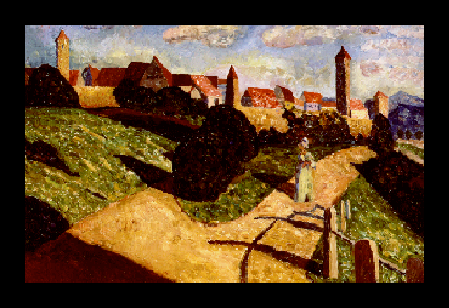
Old City (1902). 30
Old city, probably in Germany, with towers to guard it– Blue sky with almost puffy clouds A long-dressed in green lady strolls through the sunlight A fence marks her trail on the right Shade from some probably tall object, points to a dark green bush Where the trail disappears One of summer’s days The lady walking leisurely or in a hurry?
29 Stuart Kauffman: At Home in the Universe: The Search for the Laws of Self-Organization and Complexity. New York: Oxford University Press, 1995.
23 Collection du Musée National d’Art Moderne, Paris
54
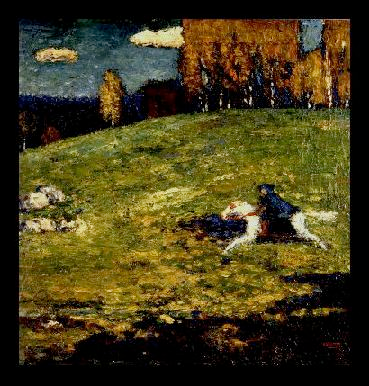
The Blue Rider (1903). 31
No leisure, no summer, no fence guarding directionBut a white horse galloping from right to left with a bluecloaked rider. The rocks to the left must be avoided, yet they are far less ominous than the turquoise sky. Clouds hover, threatening to burst into thunder soonWhite-trunked birches stand in the background with leaves turning to brown by fall—
Or is it winter already?
31 Private collection, Switzerland (Privatsammlung, Schweiz).
55
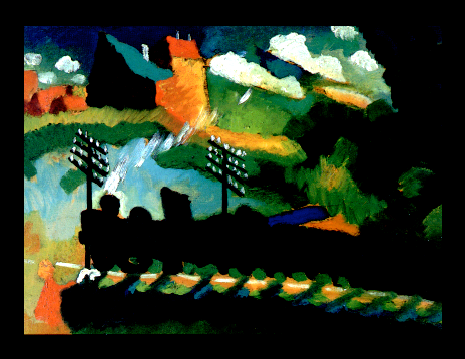
Railroad near Murnau (1909). 32
A steam engine pulls cars through lightning-struck darkness.
A lady in red waves her white handkerchief Maybe trying to stop the train? Clouds now made by the engine But: how long will the power poles manage To keep standing?
32 Lenbachhaus, Städtische Gallerie München, Deutschland.
56
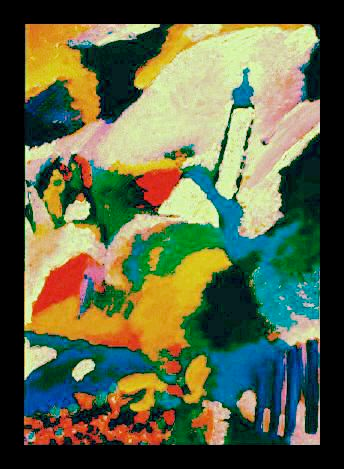
Church (1910). 33
The disaster happens, the Earth is shaking, the church
tumbling- The village sways Crashing into shapes and colors Blown by the storm From left to right this time. Some blue studs resist, holding on to the place Where the fence once was.
33 Lenbachhaus, Städtische Gallerie München, Deutschland.
57
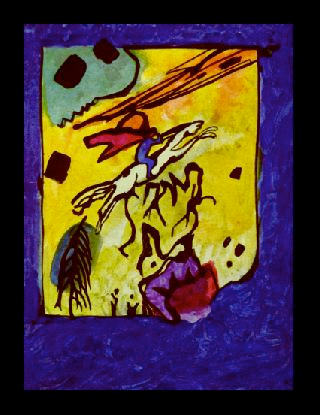
Blue Rider (1911). 34
Blue rider returns, galloping upwards-.
Jagged scars of lightning flash across the sky, showing the way. Black-doted green clouds watch over horse and riderHis cloak now has turned pink; the world yellow. On the left the birch is dying, branches drooping blue-green into dark
Yet all glued, for safety, onto blue, water-colored paper-. It is square (so far) preventing the world From falling apart.
34 Collection du Musée National d’Art Moderne, Paris
58
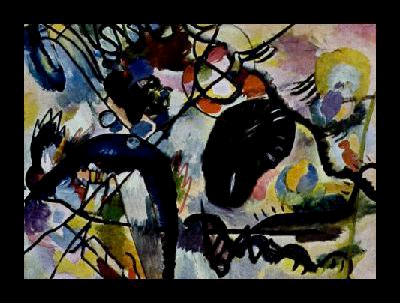
Black Spot I (1912) 35
Blue Rider’s world fell apart
Who can blame paper? A black spot with companions Escaped green cloud, intending mischief, bring forth strange tracks from creatures never yet seen.
Lines remaining in washed-out colors, probing for firmness. Something like circles, too,
But distorted, wavering formless stuff
Here and there shapes protrude from something like broken walls
Still threatened with imminent annihilation once more
This time by black spot’s closest friend.
35 The State Russian Museum, Saint Petersburg.
59
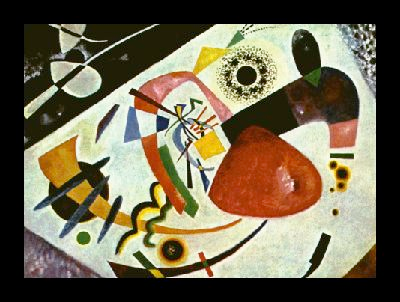
Red Spot II (1921). 36
Black spot mellowed, found a place to settle,
Almost a center, from which others can be. Its mischievous companions of old now lie still on its right, Content that others are settled in far-away places. One striped horn on a black circle tooting? Another one rolling Trying out its own markings. Yet old black-spot radiates offspring, That will bring forth A world of their own
36 Collection du Musée National d’Art Moderne, Paris.
60
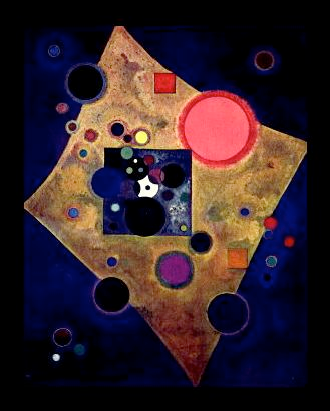
Accent in Pink (1926) 37 No pushing, no shoving From pink radiates balance On golden Ground all find peace Enjoying together What they are-
37 Collection du Musée National d’Art Moderne, Paris
61
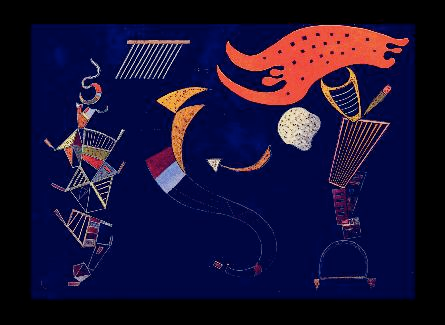
The Arrow (1943). 38 Dancing wonders The New from brought forth from the Old An arrow guiding a high-flying pair Still needing some direction Gently! All settled in friendly space Hearing the music of old From new strings.
38 Öffentliche Kunstsammlung Basel, Kunstmuseum.
62
The paintings of Vassily Kandinsky can be seen as an example of how a style appropriate for a particular time might enter a chaotic phase. Such an event could liberate the elements trapped in the old way and make them available for a new way of seeing. The nine paintings illustrate such a paradigm change.
In these paintings we see an example of how tradition can be deconstructed into elements that become integrated in new and unexpected ways to create a new world, never seen before. The Old City provides a view of reality from the Impressionist perspective. The city and its surroundings are still intact, yet the elements of the buildings—walls, gables and roofs—start pointing out their own significance. There is movement in the sky, yet the towers in the city wall still hold the clouds in position.
The galloping horse of The Blue Rider, however, cannot be stopped: it is too strong, especially with the blowing winds of the approaching thunderstorm. Galloping, the horse goes somewhere in a hurry from right to the left, but where? Because of the horse’s speed, the landscape loses definition.
63
The landscape disintegrates even more into mere shapes and colors as the steam engine in Railroad near Murnau pulls the night train even faster. The houses of Murnau lose details; walls, roofs and chimneys become colored geometric shapes, the clouds just splashes of white.
Then, in Church, an explosion in the center of the city blows the entire setting apart. Even the church flies away, its tower falling, a white rectangle separating from its blue onion-shaped steeple because the roof still holds on to its old, upright position. Like steaming clouds, the colors too become independent. Perhaps some new structure emerges through red dots and blue poles, liberated elements that create a life of their own.
Then the rider returns, galloping upwards to the right this time. But the world has changed: it is yellow now, with lines sharing the power with black splashes. Energy is blowing into the scene, this time from right to left, yet how it will affect these emancipated characters remains uncertain. In Black Spot, a black spot almost makes it into the center. Around it move uncertain colors, with no firm lines or shapes: much too much movement is still taking place for us to see how it will settle.
64
Finally, the black spot declares red as its color, and so everything else has a chance to find its place.
In the painting The Arrow a new world is born, together with new laws to organize space. It is a world of relationships between members that freely interact to the benefit of all, enhancing the uniqueness of each member. The painting expresses a new way to experience the old mystery of creation, revealing how the mutual affirmation of differences brings forth new possibilities for all.
What happened in Vassily Kandinsky’s life in one way or another happens in the life of any artist. The creation of a new style offers an understandable, timely view into the old mystery: that true unity is simple because it is one, complex because it is based on many—that is, true unity is always simplex!
65
CHAPTER III:
GOD AND CREATION: A VIEW FROM CHRISTIANITY
Faith Seeking Understanding
Christianity has always adhered to the notion that faith must seek understanding. Therefore, Christian faith cannot ignore the understandings gained by science; if it does, “faith” becomes unreasonable and is therefore in danger of sliding into a cult. As Cardinal Ratzinger (later Pope Benedict XVI) put it, “Christianity must always remember that it is the religion of the Logos.” 39
The Logos is the triune Word of God, the Word that is One in the difference of Father, Son, and Holy Spirit. He is the guide that leads the Church into the Truth of God’s revelation in Jesus Christ. The Father speaks the Word out into creation, giving with it also the grace that enables creation to receive the Word as God’s present. In this way, the truly received creative power becomes the central source of the creativity of nature.
39 Pope Benedict XVI, 2005: This lecture took place April 1. when Cardinal Ratzinger received the St. Benedict Award for the promotion of life and the family in Europe.
66
Viewed from this position, there is an answer to the question “What is the center of creation, the center of nature?” “It is the Word of God, that God spoke away into creation.” All that ever was, is today, and will be, has its roots in this center; it is that “which holds the world together” (Goethe, Faust40).
There is a paradox here, the illogicality that God can be God that which is not God. It is clearly spelled out in the prologue to John’s gospel; “In the beginning was the Word, and the Word was with God, and the Word was God. He was in the beginning with God. All things came to be through him, and without him nothing came to be” (John 1, 1–3); in Romans 11, 36: “For from him and through him and for him are all things.” In 1 Corinthians 8, 6: “Yet for us there is one God the Father, from whom all things are and for whom we exist, and one Lord, Jesus Christ, through whom all things are and through whom we exist. Furthermore, “ He (Christ) is the image of the invisible God, the first born of all creation. For in him were created all things in heaven and on earth…..all things were created through him and for him. He is before all things, and in
40 Goethe, J.von [1828–29] 2003: “Faust,”Scene 1, verses 382-383. New English Translation by A. S. Kline © https://www.poetryintranslation.com/PITBR/German/Fausthome.php
67
him all things hold together” (Colossians 1,15–17). And: “In these last days, he spoke to us through a son, whom he made hair of all things and through whom he created the universe” Hebrews 1,2). It is thanks to this creative core, the gift of God’s Word given over to creation. This is why nature is capable of becoming itself. This, however, is precisely what modern science discovered, the self-creativity, the independence, the autonomy, and the freedom of creation to become itself.
This factual independence from supernatural tutelage is, however, in such contrast with the usual religious understanding of the relationship between the Creator and creation that Christianity has a difficult time accepting such independence. However, this is really quite strange because the discovery that nature is capable of becoming itself is really in perfect harmony with the fundamental dogma of Christianity that God is love. Who ever has experienced love also has experienced the absolute necessity of the freedom to first become oneself, to be oneself. Love cannot be planned, bossed, managed, or in any other way imposed. Any loving relationship must be based on the freedom to be oneself. This
68
because: how can anyone enter into a loving relationship if she or he is not free to first become herself/himself? How could it be different in the loving relationship between God and creation? From the fundamental Christian message that God is love41 it must follow that nature must be free to become itself; no fine-tuning, no design, and no teleology. This is absolutely necessary for nature because only in this way can it bring forth naturally human beings that are also free to become themselves.
Hans Urs von Balthasar writes:
“Love, which is the highest level of union, only takes root in the growing independence of the lovers; the union between God and the world reveals, in the very nearness it creates between these two poles of being, the ever-greater difference between created being and the essentially incomparable God.” 42
The Logos, in the total otherness of creation, is the creative source that brought forth all of nature, including self-conscious human beings. Within self-consciousness it becomes obvious
41 Pope Benedict XVI, Deus Caritas Est, Encyclical Letter, 2005; https://www.vatican.va/content/benedict-xvi/en/encyclicals/documents/hf_ben-xvi_enc_20051225_deus-caritas-est.html 42 Balthasar, H.U.von, 1971: “Cosmic Liturgy: The Universe According to Maximus the Confessor.” Communio Books, Ignatius Press, , p.64.
69
that there is a hiatus between the I and the world, an abyss between myself and that which is “not I“ but “out there.” This experience of the world, of that which we are not, leads to the discovery that there is existence beyond us. Self-consciousness also will have to recognize that existence is not rooted in our doing but is “just there,” an experience that may become a source of wonder, the wonder that anything exists at all.
From the Christian perspective all existence is rooted in the Logos, the Word of God. The Word of God (in the “otherness” of creation!) is everywhere- the stars the galaxies the black wholes, the Earth and everything in and on the Earth, in plants, animals, and human beings. Christianity affirms that humans have a special place in creation. In the context that all of creation is rooted in the Word of God (given away to creation) our special position emerges from that fact that we are not “only” conscious but self-conscious. As a result of this distinctive feature we are consciously connected to the creative center of nature that brought forth everything including us. Put differently, the Word of God (in the otherness of creation) is not only the source of all that exists; it is also the creative center of our own personal existence. As a consequence the
70
very center of our self is connected to that which is beyond our self, namely to all existence. This is why our place in creation is special. The center of our self lets us discover that we are connected to all existence beyond our self. There is the recognition in the depth of our self that we are not from our self but given to our self from a long causal chain that reaches back into the origin of all of creation. At the center of our being is the truth that neither we originated from our self nor all of creation made itself. Rather, the most reasonable answer to the question from where existence is coming from is, in my view, to think of all existence as a gift
This way of thinking refreshes the Augustinian experience that there is a reality within the depth of myself that I am not, a reality that transcends the innermost of myself into the giver of this gift that is infinitely beyond myself: "Tu autem eras interior intimo meo superior summo meo"43 We received our existence because all existence is given; all emerged from the original gift, from the Logos, the Word of God given away creation. Self-consciousness can discover this origin of all
Augustine, Saint, Bishop of Hippo. [AD 397-398], 1972 “Confessions”, Menston Scolar Press.
71
creation. Self-consciousness opens the door to the central mystery of creation to the Logos, the holy source of all that is. Because of this capability to be open to this central mystery is why human beings have been thought of as being the “center of creation,” special creations representing creation (Rm: 8, 19)
Analogy of love
If God is love, what does this fundamental revelation of Christianity tell us about the origin of creation? If there is a correspondence between the love of God and the love we experience in our human relationships then the answer is: creation must be the gift of the loving God. It is possible to be even quite precise about the nature of this gift; it is the Word of God that is given to creation. We know this from the first Chapter in Holy Scripture. God speaks, and creation becomes. It is the Word of God that creates creation. God, however, speaks this Word out. It is spoken away from God, spoken into absolute nothingness, the total “otherness” of God. God is existence and absolute otherness of God is no-thing, nothing. Because God speaks his Word into absolute emptiness, nothing becomes empowered to become existence out of nothing,
72
created existence. Therefore, created being is anchored in the creative Word of God that is given away to creation. Yet, because the Word of God is the gift of God to creation it belongs to creation, creation owns it! 44
The Word of God, the Son of God, is the Trinitarian Word of God. It is therefore eternal, co-eternal with the Father and the Holy Spirit. The Trinitarian Unity of Father, Son, and Holy Spirit is Trinitarian eternal existence. God does not participate in existence; God is existence.45 The question, therefore, arises whether there is an imprint of the Trinitarian existence of the Word of God in creation? Since it is the Word of God that is the creative center of nature, are there reflections of its Trinitarian existence? I think the answer is “yes”! In this investigation I have tried to describe how the process that brings forth creation, is the process of sequential syntheses. Anything that comes into existence emerges from unifying difference, quantitative an/or qualitative into unity. In other words, all that is real exists as unity in diversity. Therefore,
44 See: Ulrich, F. e.g. “Gabe und Vergebung, Ein Beitrage zur Biblischen Ontoglogie.” Schriften V, Heausgegeben und eingeleited von Stefan Oster, Johannes Verlag Einsiedeln, Freiburg 2006, pp.8ff. 45 Thomas Aquinas, “The Summa Theologica”: First Part, Question 4: “Of the Simplicity of God.” Benziger Bros. edition, 1947, translated by Fathers of the English Dominican Province.
73
from the very beginning of creation there is the same ontological structure of existence, the new always emerges from elements that were already previously unified (see: “The nature of the creative process, p.32).
God is Trinitarian existence, Unity in the diversity of Father, Son and Holy Spirit. Created existence reflects this Trinitarian “existence” of God because all created existence also exists as united diversity. Hans Urs von Balthasar, commenting on Maximus Confessor writes:
“Here, in the end, is the inconceivable fecundity of this divine unity: on the one hand, it is the cause of the unity of all things and of their respective differences; it makes each of them an image of the divine unity and uniqueness; it is the basis of what is most personal and immediate in each of them. On the one hand, this divine unity is, in itself, the overflowing unity and root of identity of these individuals, the source of their community an their loving communion. This paradox of a synthesis that unites creatures by distinguishing them and distinguishes them by uniting them—a paradox that can be found throughout the whole edifice of the universe—takes its origin in the most original relation of all things: their relation to God.” 46
Unification of diversity brings forth new wholes, new
46 Balthasar, H.U.von: 1971: “Cosmic Liturgy: The Universe According to Maximus the Confessor.” Communio Books, Ignatius Press, p.67-68.
74
Gestalts. Gestalts are always one, wholes, the architecture of which is that the whole is always more, in quantity and quality, than its parts. United diversity is the ontological structure of all that is. All that is, therefore, carries the Trinitarian watermark of the eternal “existence” of God
This gift of God is the creative Word, the Logos of God. It is God’s gift to creation and that is why the Word of God that is God, becomes that which is not God, the creative center of creation. Because of this gift of God to creation nature is capable of becoming itself
God’s logic of incarnation
Within the history of time the Logos appears in the Christmas event. It is the precise point in time in which the paradox that God can be God in that, which is not God but a human being, becomes apparent. For our logic it is impossible that something can be that, which it is not; for God’s logic, however, there is no obstacle here.
Once we understand that we cannot understand God’s logic of incarnation we might be better equipped to appreciate other dimensions of God’s logic. For example God’s logic of
75
incarnation might not only be the center of Christmas but also the logic of the Eucharist. Here that which is certainly not God, namely bred and wine becomes God, the body and blood of Christ. 47
As I see it, the paradox of incarnation is also at the center of creation. The thought here is that just as Christ is true God in the total otherness of bred and wine in the Eucharist and of a human being in the Christmas event, so the Word of God that is God is also incarnate in the total otherness of God in creation. From this perspective the center of creation is God himself but in the absolute, difference of creation. In this view God’s logic of incarnation freely agrees to enter into a relationship with creation, a relationship that could not be any deeper or more intimate. God ties himself into bondage with creation, with that, which is essentially total otherness of God.
Seen from a political angel such action would be considered foolish, imprudent if not insane! Why would anyone of healthy mind enter such an adventure of giving oneself up into total alienation? To totally loose oneself, giving oneself up into a relationship with a free agent over which there is no control?
47 Brun, R. 2007 : “Cosmology, Cosmic Evolution, and Sacramental Reality: A Christian Contribution.” ZYGON, vol. 42, no. 3, September.
76
The only unreasonable reason we can think of to consider such foolish action may be love. Love is blind! “The heart has reasons that reason doesn't’ know.” (“Le coeur a ses raisons, que la raison ne connaît point.” Blaise Pascal48). We know how this love story ends. It is the dramatic story of the life, teaching, death, and resurrection of Jesus Christ.49 It is the drama that unfolds as a consequence of God’s logic of incarnation, to create creation as well as to save it. The love of God expressed in his logic of incarnation, Christ expressing this logic of love for creation by giving himself over to creation so that it can freely create itself and also saving creation to accomplish in time what God’s logic of incarnation was, is, and will be for all eternity. Christ dying on the cross giving his life to creation is the realization in time of God’s logic of incarnation. Through this logic creation is not only created but also saved. As a consequence of this logic the love of God for creation penetrates creation not only from the topdown but also from the very center of creation bottom-up
What happens to God’s gift of his Word as it enters the history of creation, of that it brought forth? The birth of Christ
48 Source: https://en.wikiquote.org/wiki/Blaise_Pascal 49 Balthasar, H.U.von, 1994: ”Theodrama” Vol IV, Ignatius Press, San Francisco, pp. 317-406
77
is the event in which eternity crosses the history of time.50 Incarnation is the appearance in time of God’s eternal logic of incarnation. Christmas, therefore, is the actualization of God’s eternal “decision” to create by giving away His Son, His creative Word, so that the world may come into being not eternal “existence” but created existence.
What happens to this gift of God as it enters the history of creation is the drama of the life and death of Christ.51 It is the drama played out as the Son of God is born into the history of its own creation. “He was in the world, and the world came to be through him, but the world did not know him. He came to what was his own in his own, but his own people did not accept him” (Jn 1, 10-11).
Christianity knows that God is love. Christianity therefore also knows that freedom is essential for entering or rejecting any loving relationship: “Without freedom there cannot be love.” 52
50 See: Balthasar H, U, von 1994: “A Theology of History” (Communio Books) Ignatius Press 51 Deane-Drummond, C. 2009: ”Christ and Evolution.” Fortress Press,Minneapolis, pp. 33-128. 52 Pope John Paul II, 1986: “Divine Providence and Human Freedom.” General Audience, May 21.
78
Providence
If nature (creation) is totally free to construct itself, how can creation fulfill the providential plan of God? There is again another Christian paradox here. We can never understand how the freedom of nature (creation) to become itself will also necessarily fulfill the providential plan of God. In our logic, freedom precludes being managed! In considering freedom and providence we can only acknowledge that our logic cannot grasp how God’s plan for creation can include the freedom of creation to become itself. Christian faith must accept that our logic cannot understand the “logic” of God’s “planning.”
Christianity faces here the paradox that God’s providence for creation does not exclude the freedom of creation to become itself. As I see it, the passion of Christ demonstrates that providence and freedom are not mutually exclusive. This because all involved in the drama of the passion of Christ are acting freely, according to their free will and purpose. Yet, precisely through their free actions, the saving plan of God becomes fulfilled with absolute precision—even the cock crows at precisely the “planned” moment!
79
Faith can “understand” the paradox how God’s providence becomes reality in spite of the free actions of human beings. It is reasonable for our human logic to accept God’s ways of providential actions that we cannot understand; the “logic” of God’s providence for creation is rooted in the love of God that is beyond any rational understanding. 53
God and Creation: A Glance at Other Models of Thought
The view in this book is sketched from the perspective of the central dogma of Christianity, that God is love. From this foundation it follows that creation is the gift of a loving God. The gift is his creative Word that is God. Yet this gift is a real gift, given away to a creation that is essentially not God. Can this perspective provide a link to other models of thought—to pantheism, panentheism, and atheism?
53 The multiple interventions of God into the history of Israel show that God is in command; in spite of human freedom, God’s will prevails. This assures God’s people that, whatever happens, God will see to it that his will is fulfilled.
80
Pantheism
Roughly speaking, pantheism sees the world as being divine. No personal God exists; rather, everything that is—the total universe, the Unity of everything—is divine. “The Unity encompasses the conscious and unconscious, the mental and the physical without itself being conscious.54 A modern version of pantheism might be called religious naturalism, a view held by quite a few scientists who are engaged not only in pursuing their particular research but also in constructing a world-view that explores the mysterious origins of nature. Through their research they can choose to follow a path that leads from the scientific understanding of their research object to a deeper but more mysterious exposure to the constructs of nature. Such encounters have led to a new version of pantheism. Examples of such neopantheism can be found in the work of Stuart Kauffman, the modern Spinoza,55 or the insights of Ursula Goodenough, who writes about the “Sacred Depths of Nature.” 56
54 Levine,M. 1994: “Pantheism, a Non-Theistic Concept of Deity.” London and New York: Routledge, p. 115. 55 Kauffman, S. 1995: “At Home in the Universe: Search for the Laws of Self-Organization and Complexity.” Oxford; New York: Oxford University Press 56 Goodenough, U. 1998: “The Sacred Depths of Nature.” New York: Oxford University Press,
81
Science by its very nature will sooner or later nudge scientists toward having to ponder the deep dimension of origin. Science itself poses the ontological question about the nature of being, the nature of existence, which is ultimately “What is the nature of Nature?”
From the perspective outlined in this booklet, namely from the paradox that God can be God in that which is absolutely different from God, it is understandable that Pantheism experience nature as being divine. The illogicality of the mystery of incarnation represents a peak of Christian revelation. It is reasonable to slide from this peak back into human logic. Something can indeed not be that which it is not, except for the logic of God. The eyes of faith can see that there is no obstacle for the Word of God that is God to become that, which is certainly not God but a human being, Jesus Christ. Pantheism looses the Christian paradox of incarnation by flattening the absolute otherness of creation from God into identity with God. By doing so Pantheism replaces God’s logic with human logic.
82
Panentheism
Panentheism refers to the work of Alfred North Whitehead and some of the expansions to his work by the American philosopher and theologian Charles Hartshorne. Hartshorne agrees with Whitehead in that “every event on its finer side introduces God into the world.” For Hartshorne God must be considered as a dipolar entity: 57 One pole of God is his unchanging eternity; the other pole of God is his becoming together with creation. The analogy used by panentheism to explain the relationship between God and the world is that the world is the body of God. 58
Hartshorne argues that God is involved in bringing forth the world because “the only positive explanation of order is the existence of an orderer. Hence evolution is not, I hold, fully intelligible without God. And since God means supreme freedom dealing with lesser freedom, there must be a persuasive element of chance in nature. So the specifics of nature cannot be mere actualization of divine plan. The
L57 Boyd A. 1992: “Trinity and Process. A Critical Evaluation and Reconstruction of Hartshorne’s Di-Polar Theism towards a Trinitarian Metaphysics.” City: Publisher, , pp. 196– 205. 58 Ibid., p. 79.
83
renunciation of strict determinism, which does no real work in science anyway, opens the door to a new form of theologizing, purified of the taint of divine tyranny which disfigured the classical theology.”59 What remains changeless is only God’s perfect responsiveness to all that is changing.
Because the creative process is not predetermined but contingent, open into the future, God cannot know everything. Because the creative process is undetermined, the future is unknown to God. Because God is good, he attempts to draw creation toward that which is good. But evil also exists in the world. In this view, the reality of evil clearly establishes that God cannot prevent evil from happening. The reality of evil therefore makes it obvious that God is not almighty. 60
Panentheism also tries to answer the question “What is the nature of nature?” Doing justice to the discoveries of modern science, panentheism emphasizes the single creative process that has brought forth everything material and mental. Panentheism highlights the fact that creation is not an event that happened in the past but is a continuous process
59 Hartshorne, C. 1984: “Omnipotence and other Theological Mistakes.” Albany: State University of New York Press, p. 71. 60 Ibid., pp. 10–13.
84
throughout the entire history of nature. This point of view compelled some theologians to do justice to this concept by suggesting that the creator brings forth new existence at all times. Therefore, “…God is the immanent creator creating in and through the process of the natural order. Hence it is that many thinkers, reflecting on these new perspectives of the sciences on the evolving natural and human worlds, have resorted to affirming that, in some sense or other, the world is ‘in’ God and God is ‘in’ the world.” 61
The question arises, in what sense is the world in God and God in the world? “Common to key pantheists, and which effectively explicate the ‘in,’ is as follows: ‘the cosmos as God’s body; language of “in and through”; the cosmos as sacrament; language of “inextricable intertwining”; the dependence of God on the cosmos; the intrinsic, positive value of the cosmos; possibility; and degree Christology. These features can be applied as a test to theologians to see whether or not they can be described as panentheists.” 62
61 Peacock, A. 2004: “In Whom We Live and Move and Have Our Being: Panentheistic Reflections on God’s Presence in a Scientific World. “ Philip Clayton and Arthur Peacock, Eds. Grand Rapids, Michigan, and Cambridge, U.K.: William B. Eerdmans Publishing Company, 2004, pp. XX–XXi 62 Brierley, M. 2004: In Whom We Live and Move and Have Our Being: Panentheistic Reflections on God’s Presence in a Scientific World. Philip Clayton and Arthur Peacock, Eds. Grand Rapids, Michigan, and Cambridge, U.K.: William B. Eerdmans Publishing Company, p. 6.
85
Panentheism understood in this way misses the central point of Christianity, namely that God is love. It misses this central revelation because a loving relationship can only exist between partners that are free to reject or enter such a relationship. If God is dependent on the cosmos and “ inextricably intertwined” with it, neither God nor human beings (that represent creation ) can be free. No freedom, no loving relationship! Consequently, the drama of Christ’s passion is not the saving act of God freely chosen from eternity to save creation but is the result of God being captive of the cosmos, his body.
From the Christian perspective of incarnation Panentheism reduces the absolute difference between God and creation into God’s dependence on creation. By doing so it eliminates freedom on both sides; God depends on creation and creation depends on God. This mutual dependence negates freedom and therefore negates love. As a consequence, Panentheism kills Christianity by stabbing it into its heart.
86
Atheism
Atheism is in contrast to theism, the belief that at least one deity exists. Atheism rejects this idea and also asserts that there is no existence beyond this world.
This view has its origin in antiquity but became a central topic of discussion during the period of the Enlightenment. Scientists demonstrated that the world followed natural laws and was therefore not dependent on the actions of supernatural beings. For example, Isaac Newton’s discovery of the law of gravity made obsolete the view that supernatural beings were keeping the planets on their trajectories. .
As the sciences advanced, more and more beliefs in supernatural involvement in the world found natural explanations instead. One of the most significant scientific breakthroughs was the discovery by Charles Darwin convincingly documented in 1859, that the two-step process of variation between the individuals of a species and natural selection could generate new species.63 New forms of life, then, were created not by God but by nature.
63 Darwin, Ch. 1859: ”On the Origin of Species by Means of Natural Selection, or the Preservation of Favoured Races in the Struggle for Life. London: John Murray,
87
The eighteenth and nineteenth centuries brought not only great advances in the sciences but also revolutionary new perspectives in philosophy. Immanuel Kant revolutionized the human understanding of the world by suggesting that human understanding could only construct models of reality rather than approach reality itself. He wrote in 1781:
“Hitherto it has been assumed that all our knowledge must conform to objects. But all attempts to extend our knowledge of objects by establishing something in regard to them a priori, by means of concepts, have, on this assumption, ended in failure. We must therefore make trial whether we may not have more success in the tasks of metaphysics, if we suppose that objects must conform to our knowledge.” 64
This suggests that human thought may only be able to construct models of reality but cannot touch reality itself.
Plato already had proposed that the world was only an imprint of the creator’s ideas; the eternal ideas by themselves could not be grasped by human concepts or human minds. Kant had pious respect for the unreachable real reality of the world. Yet his suggestion that our concepts cannot reach
64 Kant, I. [1787]: Preface to the second edition of the “Critique of Pure Reason”. Basingstoke: Palgrave Macmillan, 2007.
88
objective reality but instead are only constructs of the subjective human mind led to a surprising logical consequence. For example, Ludwig Feuerbach writes:
“What we have so far maintained concerning the general relationship between man and his object, and between man and sensuous objects, is particularly true of man’s relationship to the religious object. In view of its relation to the objects of the senses, the consciousness of the object can be distinguished from self-consciousness; but, in the case of the religious object, consciousness and self-consciousness directly coincide. A sensuous object exists apart from man, but the religious object exists within him—it is itself an inner, intimate object, indeed, the closest object, and hence an object which forsakes him as little as his self-consciousness or conscience. The consciousness of God is the self-consciousness of man; the knowledge of God is the self-knowledge of man; the knowledge of God is the self-knowledge of man”. 65
As a consequence of this discovery, God is dead! If this is true, why do religions still exist? They persist because they are extremely useful instruments of power and control, as we can
65 Feuerbach, L. L. [1843], 1957: “The Essence of Christianity “ New York, Harper, .
89
still perceive today! In addition, religion might also serve to drug the masses into conformity; Karl Marx referred to religion as “ the opium for the people.”
In recent times, quite a few authors have proposed that religion is an outcome of human evolution. 66 Beliefs in supernatural beings facilitated the “understanding” of the powers of nature. Ghosts, spirits, and deities “explained” the inexplicable; the phenomena of nature—volcanic eruptions, earthquakes, lightening, thunder, and the like—were viewed as actions of God(s). In addition, the invention of deities required the consecration of special individuals who were gifted to interact with and appease the gods through ceremonies and sacrifice. Rulers frequently propagated the belief that they were in contact with deities or were ordained by the gods to rule; sometimes they even claimed that they were gods themselves. Such beliefs allowed priests, shaman and kings to unify human groups into firm, conjoined entities that could conquer foreign groups in battle. They used these beliefs to gather and reinforce their power and resources, and these beliefs helped to increase the power of the group. The
66 See for example: Boyer, P. 2001, “Religion Explained: The Evolutionary Origins of Religious Thought.” New York: Basic Books,.
90
gruesome tendency of religion to justify its actions through
In my view, the position that religion is anchored in human evolution is well founded. The uniting capacity of religious believes to strengthen group identity is obvious through out human history. Countless wars have been fought and are still being fought today with the pretext of obeying some goodly requests. On the one hand the discovery about the origin of religion and its function contributes to modern versions of pantheism and atheism. This because either there is only the natural “deity” of nature or there is no deity at all.
Fair enough! But there is still the old problem of origin, from where does the cosmos come from, “why is there something instead of nothing?” This question still requires and answer.
But does it really?
Modern physics is difficult to understand, especially the physics of elementary particles. Quantum mechanics reigns at this level, challenging concepts gained at the “household level” of everyday life. At the everyday level of human understanding, “Why is there something instead of nothing?” conveys the message that out of nothing no-thing can come. But this “truth”
91
is not so at the quantum level. There, virtual particles pop in and out of existence but at such speeds that no one can measure them. Lawrence Kraus writes,
“These quantum fluctuations imply something essential about the quantum world: nothing always produces something, if only for an instant.” 67 After discussing the impact of a quantum theory of gravity that I, a non physicist, do not understand, Kraus continues: “The lesson is clear: quantum gravity not only appears to allow universes to be created from nothing—meaning, in this case, emphasize, the absence of space and time—it may require them. ‘Nothing’—in this case no space, no time, no anything!—is unstable 68 (original italic).
“Furthermore: “Why is there something rather than nothing must be understood in the context of a cosmos where the meaning of these words is not what it once was, and the very distinction between something and nothing has begun to disappear, where transitions between the two in different contexts are not only common, but required.” 69
What more is there to say? In the light of modern physics, the meaning of “something” in contrast to “nothing” seems to be
67 Kraus, L. 2012: “A Universe from Nothing.” New York: Free Press,, , p.153. 68 Ibid., p. 170. 69 Ibid., pp. 182–183.
92
melting away. If Lawrence Kraus and his colleagues are right, science again fills in a gap in our knowledge that previously only the creative action of God could “close.” If God is only a construction of the human mind and science finds that a creator is really not needed because there is a natural way that “nothing” can become “something,” God is really dead!
Or: “Is he?”
The thesis of this writing is that God is love and that therefore creation is God’s gift. Any true gift is given away, departs from the giver so that it can be truly received by the one who gets the gift. As a consequence of giving a gift away it belongs now to the one who receives it. The giver might expect a “thank you!”but personal experience teaches us that this is not necessarily the case. I understand the reasons why someone may become an atheist: there is the insight from science that religion is an evolutionary adaptation of human groups, it unified the group to increase the chances to win fights with competing groups; the voracious fighting between human groups for resources under the pretext of God-ordained actions is still going on; the troublesome trend of religious institutions
93
to increase their power through condemnation, censorship and suppression of different views is still an actual theme, and the discrimination against anyone who does not belong to the wegroup is still with us today. These are just a few reasons to become existentially alienated to any variety of religion.
Within the history of religions there is, however, the phenomenon of Christianity. This is not to say that Christianity is exempt from the reasons to be an atheist listed above. It is not! But from the core of Christianity there is the message that "You have heard that it was said, 'Love your neighbor and hate your enemy.' But I tell you: Love your enemies and pray for those who persecute you ” (Mt. 5:43-44). This is not a mantra that has its roots in evolutionary adaptation- it comes from a totally different source; Christianity originates from within the life history of one person. This person claimed to be equal with God, to be the Son of God. Some interpreted such a statement as coming from a mad man, but others were amazed by Christ’ s powerful speaking and were also impressed by his amazing deeds.
94
Scrutinizing the life of Christ the question will come up: “Is it reasonable to believe his testimony that he is sent by God? The answer to this question must be found by each person for here or himself, it cannot be imposed by anyone be it parents, teachers, or institutions. Once this answer may have become a stuttering“ yes ”the next question might be: “What is the message? What is the center of Christ’s testimony? Looking back on Christ’s teachings, life, death, and resurrection it is for us clearer to see that Christ testified that God is love. By dying on the cross Christ fulfilled the Father’ s eternal plan to create the world. He did so by speaking out, giving away his eternal Word to the world so that that, which is not God but creation may become its own existence. By giving away his Son to the world the Father also crafted the way to make holy even that, which is not God.
These are the deeds of the Father, anchored in the love of God for all eternity. The bottom line is that creation is the gift of the loving God; to say thanks for this gift is the adequate existential response for all. We too, are a part of created existence and that is why the Word of God in the otherness of
95
creation is also the center of our being. Even those who call themselves atheists will discover God’s gift of existence in the depth of their own existence. This center of being will become the fertile ground from which to live a thankful life.
As I see it, reading about the life of Christ and pondering his teachings and actions is the only way to become convinced that there is a God. And after all thought is thought and all science is done, neither can prove nor disprove that God exists. Only by assimilating the story of the life, teachings, death, and resurrection of Christ will we, by the grace of God, find faith in God. There is no credible argument or prove that God exists. Only the life, teachings, death, and resurrection of Christ may
“prove” to our heart and mind that there is a God, and that He is love.
Because: “LOVE ALONE IS CREDIBLE.” 70
70 Balthasar, H. U. von 2005: “Love Alone Is Credible.” Ignatius Press.
ADDENDUM
NATURE, International weekly journal of science.
First issue, Nov. 4, 1869.
NATURE: APHORISMS BY GOETHE
NATURE! We are surrounded and embraced by her: powerless to separate ourselves from her, and powerless to penetrate beyond her.
Without asking, or warning, she snatches us up into her circling dance, and whirls us on until we are tired, and drop from her arms.
She is ever shaping new forms: what is, has never yet been; what has been, comes not again. Everything is new, and yet nought but the old.
We live in her midst and know her not. She is incessantly speaking to us, but betrays not her secret. We constantly act upon her, and yet have no power over her.
The one thing she seems to aim at is Individuality; yet she cares nothing for individuals. She is always building up and destroying; but her workshop is inaccessible.
97
Her life is in her children; but where is the mother? She is the only artist; working-up the most uniform material into utter opposites; arriving, without a trace of effort, at perfection, at the most exact precision, though always veiled under a certain softness.
Each of her works has an essence of its own; each of her phenomena a special characterization: and yet their diversity is in unity.
She performs a play; we know not whether she sees it herself, and yet she acts for us, the lookers-on.
Incessant life, development, and movement are in her, but she advances not. She changes forever and ever, and rests not a moment. Quietude is inconceivable to her, and she has laid her curse upon rest. She is firm. Her steps are measured, her exceptions rare, her laws unchangeable.
She has always thought and always thinks; though not as a man, but as Nature. She broods over an all-comprehending idea, which no searching can find out.
Man kind dwell in her and she in them. With all men she plays a game for love, and rejoices the more they win. With many, her moves are so hidden, that the game is over before they know it.
That which is most unnatural is still Nature; the stupidest philistinism has a touch of her genius. Whoso cannot see her every where, sees her nowhere rightly.
98
She loves herself, and her innumberable eyes and affections are fixed upon herself. She has divided herself that she may be her own delight. She causes an endless succession of new capacities for enjoyment to spring up, that her insatiable sympathy may be assuaged.
She rejoices in illusion. Whoso destroys it in himself and others, him she punishes with the sternest tyranny. Whoso follows her in faith, him she takes as a child to her bosom.
Her children are numberless. To none is she altogether miserly; but she has her favorites, on whom she squanders much, and for whom she makes great sacrifices. Over greatness she spreads her shield.
She tosses her creatures out of nothingness, and tells them not whence they came, nor whither they go. It is their business to run, she knows the road.
Her mechanism has few springs -- but they never wear out, are always active and manifold.
The spectacle of Nature is always new, for she is always renewing the spectators. Life is her most exquisite invention; and death is her expert contrivance to get plenty of life.
She wraps man in darkness, and makes him for ever long for light. She creates him dependent upon the earth, dull and heavy; and yet is always shaking him until he attempts to soar above it.
She creates needs because she loves action. Wondrous! that
99
she produces all this action so easily. Every need is a benefit, swiftly satisfied, swiftly renewed.-- Every fresh want is a new source of pleasure, but she soon reaches an equilibrium
Every instant she commences an immense journey, and every instant she has reached her goal.
She is vanity of vanities; but not to us, to whom she has made herself of the greatest importance. She allows every child to play tricks with her; every fool to have judgment upon her; thousands to walk stupidly over her and see nothing; and takes her pleasure and finds her account in them all.
We obey her laws even when we rebel against them; we work with her even when we desire to work against her.
She makes every gift a benefit by causing us to want it. She delays, that we may desire her; she hastens, that we may not weary of her.
She has neither language nor discourse; but she creates tongues and hearts, by which she feels and speaks.
Her crown is love. Through love alone dare we come near her. She separates all existences, and all tend to intermingle. She has isolated all things in order that all may approach one another. She holds a couple of draughts from the cup of love to be fair payment for the pains of a lifetime.
She is all things. She rewards herself and punishes herself; is her own joy and her own misery. She is rough and tender, lovely and hateful, powerless and omnipotent. She is an
100
eternal present. Past and future are unknown to her. The present is her eternity. She is beneficent. I praise her and all her works. She is silent and wise.
No explanation is wrung from her; no present won from her, which she does not give freely. She is cunning, but for good ends; and it is best not to notice her tricks.
She is complete, but never finished. As she works now, so can she always work. Everyone sees her in his own fashion. She hides under a thousand names and phrases, and is always the same. She has brought me here and will also lead me away. I trust her. She may scold me, but she will not hate her work. It was not I who spoke of her. No! What is false and what is true, she has spoken it all. The fault, the merit, is all hers.
So far Goethe.
When my friend, the Editor of NATURE, asked me to write an opening article for his first number, there came into my mind this wonderful rhapsody on ''Nature,'' which has been a delight to me from my youth up. It seemed to me that no more fitting preface could be put before a Journal, which aims to mirror the progress of that fashioning by Nature of a picture of herself, in the mind of man, which we call the progress of science.
A translation, to be worth anything, should reproduce the words, the sense, and the form of the original. But when that original is Goethe's, it is hard indeed to obtain this ideal; harder still, perhaps, to know whether one has reached it, or only added another to the long list of those who have tried to
101
put the great German poet into English, and failed.
Supposing, however, that critical judges are satisfied with the translation as such, there lies beyond them the chance of another reckoning with the British public, who dislike what they call ''Pantheism " almost as much as I do, and who will certainly find this essay of the poet's terribly Pantheistic. In fact, Goethe himself almost admits that it is so. In a curious explanatory letter, addressed to Chancellor von Muller, under date May 26th, 1828, he writes:
''This essay was sent to me a short time ago from amongst the papers of the ever-honoured Duchess Anna Amelia; it is written by a well-known hand, of which I was accustomed to avail myself in my affairs, in the year 1780, or thereabouts.
''This essay was sent to me a short time ago from amongst the papers of the ever-honoured Duchess Anna Amelia; it is written by a well-known hand, of which I was accustomed to avail myself in my affairs, in the year 1780, or thereabouts.
''I do not exactly remember having written these reflections, but they very well agree with the ideas which had at that time become developed in my mind. I might term the degree of insight which I had then attained, a comparative one, which was trying to express its tendency towards a not yet attained superlative.
''There is an obvious inclination to a sort of Pantheism, to the conception of an unfathomable, unconditional, humorously self-contradictory Being, underlying the phenomena of Nature; and it may pass as a jest, with a bitter truth in it.''
Goethe says, that about the date of this composition of ''Nature " he was chiefly occupied with comparative anatomy; and, in 1786, gave himself incredible trouble to get other people to take an interest in his discovery, that man has a intermaxillary
102
bone. After that he went on to the metamorphosis of plants, and to the theory of the skull; and, at length, had the pleasure of seeing his work taken up by German naturalists. The letter ends thus:--
''If we consider the high achievements by which all the phenomena of Nature have been gradually linked together in the human mind; and then, once more, thoughtfully peruse the above essay, from which we started, we shall, not without a smile, compare that comparative, as I called it, with the superlative which we have now reached, and rejoice in the progress of fifty years.''
Forty years have passed since these words were written, and we look again, ''not without a smile, " on Goethe's superlative. But the road which led from his comparative to his superlative, has been diligently followed, until the notions which represented Goethe's superlative are now the commonplaces of science -- and we have super-superlative of our own.
When another half-century has passed, curious readers of the back numbers of NATURE will probably look on our best, ''not without a smile;" and, it may be, that long after the theories of the philosophers whose achievements are recorded in these pages, are obsolete, the vision of the poet will remain as a truthful and efficient symbol of the wonder and the mystery of Nature.
T. H. HUXLEY

Nature © Macmillan Publishers Ltd 1869 Registered No. 785998 Engla
103
REFERENCES
Augustine, Saint, Bishop of Hippo. [AD 397-398], 1972 “Confessions.” Menston Scolar Press.
Aquinas, Th. [1225/7- 1274 ] “The Summa Theologica”: First Part, Question 4: “Of the Simplicity of God.” Benziger Bros. edition, 1947, translated by Fathers of the English Dominican Province.
Balter, M. 2002: “What made humans modern?” Science, Vol. 295, pp. 1219– 1225.
Balthasar, H.U.von, 1971: “Cosmic Liturgy: The Universe According to Maximus the Confessor.” Communio Books, Ignatius Press, , p.64.
Balthasar, H.U.von, 1994: ”Theodrama” Vol IV, Ignatius Press, San Francisco, pp. 317-406.
Balthasar. H, U, von 1994: “A Theology of History” (Communio Books) Ignatius Press.
Balthasar, H. U. von 2004: “Love Alone Is Credible.” Ignatius Press., San Francisco.
Borucki, W. et al. 2013: “Kepler-62: A Five-Planet System with Planets of 1.4 and 1.6 Earth Radii in the Habitable Zone.” Science vol. 340, 3 May: pp. 587- 590.
Boyd A. 1992: “Trinity and Process. A Critical Evaluation and Reconstruction of Hartshorne’s Di-Polar Theism towards a Trinitarian Metaphysics.” City: Publisher, pp. 196–205.
Boyer, P. 2001: “Religion Explained. The Evolutionary Origins of Religious Thought.” New York, Basic Books, p. 2.
Brierley, M. 2004: In Whom We Live and Move and Have Our Being: Panentheistic Reflections on God’s Presence in a Scientific World. Philip Clayton and Arthur Peacock, Eds. Grand Rapids, Michigan, and Cambridge, U.K.: William B. Eerdmans Publishing Company, p. 6.
104
Brun, R. 2007 : “Cosmology, Cosmic Evolution, and Sacramental Reality: A Christian Contribution.” Zygon, vol. 42, no. 3, September.
Chagall, M. https://www.brainyquote.com/authors/marc-chagall-quotes
Chardin, T. de: “The human phenomenon” [1955] 1999. A new edition and translation of Le phénomène humain by Sarah Appleton-Weber ; with a foreword by Brian Swimme. Sussex Academic Press.
Chen G. et al. 2012: “Hsp90 stress potentiates rapid cellular adaptation through induction of aneuploidy.” Nature, vol. 482, p. 246.
Chen I.. and Walde P. 2010: “From Self-Assembled Vesicles to Protocells.” Cold Spring Harbor, Perspectives in Biology.
Darwin, Ch. [1859] 1902: “The Origin of Species by means of natural selection or the preservation of favoured races in the struggle for life.” Sixth edition, Edinburgh Press, pp. 159–160
Deane-Drummond, C. 2009: ”Christ and Evolution.” Fortress Press,Minneapolis, p. 33.
Eldredge N., and Gould S. 1972: “Punctuated Equilibria: An Alternative to Phyletic Gradualism.” In Models in Palaeobiology. San Francisco: Freeman, Cooper and Co., 1972, pp. 82–115.
Elis, G. 2008: “Patchy solutions.” Nature, vol. 452, p. 158, March.
Feuerbach, L. 1843: "On the Essence of Religion" In: The Essence of Christianity, second edition. Translated from the German by George Eliot. Introductory essay by Barth,K. Foreword by H. Richard Niebuhr, R. 1957. New York, Harper; § 2.
Goethe, J. W. von [1808] 2003: “Faust,”Scene 1, verses 382-383. New English Translation by A. S. Kline, https://www.poetryintranslation.com/PITBR/German/Fausthome.php
Goethe, J. W.von: “Aphorisms on Nature.” See addendum to this book https://www.nature.com/nature/first/aphorisms.html
105
Goodenough, U. 1998: “The Sacred Depths of Nature.” New York: Oxford University Press.
Gould, S. 1980: “Is a New and General Theory of Evolution Emerging?” Palaeobiology, vol. 6 (1), 1980, p. 129.
Hartshorne, C. 1984: “Omnipotence and other Theological Mistakes.” Albany: State University of New York Press, p. 71.
Jung, C. G. [1939], 1968: “The Archetypes and the Collective Unconsciousness.” The Collected Works of C. G. Jung, Volume 9, part 1. Bollingen series XX. Second edition, Princeton, NJ: Princeton University Press, p. 280.
Kauffman, S. 1993: “The Origins of Order: Self-Organization and Selection in Evolution.” New York, Oxford, Oxford University Press, pp 30/31.
Kauffman, S. 1995: “At Home in the Universe.” The Search for the Laws of Self-Organization and Complexity.” Oxford University Press.
Kant, I. [1787]: Preface to the second edition of the “Critique of Pure Reason”. Basingstoke: Palgrave Macmillan, 2007
Kevin. K. and Rajewsky, N. 2007: “The evolution of gene regulation by transcription factors and microRNAs.” Nature Reviews Genetics, vol. 8, pp. 93– 103.
Kraus, L. 2012: “A Universe from Nothing.” New York: Free Press, , p.153.
Levine,M. 1994: “Pantheism, a Non-Theistic Concept of Deity.” London and New York: Routledge, p. 115.
Lordkipanidze, D. et al. 2013: “A Complete Skull from Dmanisi, Georgia, and the Evolutionary Biology of Early Homo.” Science vol. 342, pp 326-331.
106
Mayr, E. 1982,: “The Growth of Biological Thought. Diversity, Evolution, and Inheritance.” Cambridge, MA, The Belknap Press, p. 480. Monod, J. 1971: “Chance and Necessity. An essay on the natural philosophy of modern biology.” New York, Random House 1971.
Pascal, B. Source: https://en.wikiquote.org/wiki/Blaise_Pascal
Plotinus, [ca. A.D. 204–270] 1929 MacKenna, tr. Class. Rev. 1929, p. 614.
Peacock, A. 2004: “In Whom We Live and Move and Have Our Being: Panentheistic Reflections on God’s Presence in a Scientific World. “ Philip Clayton and Arthur Peacock, Eds. Grand Rapids, Michigan, and Cambridge, U.K.: William B. Eerdmans Publishing Company, 2004, pp. XX–XXi.
Pope Benedict XVI, 2005: This lecture took place April 1 when Cardinal Ratzinger received the St. Benedict Award for the promotion of life and the family in Europe.
Pope Benedict XVI, 2005: Deus Caritas Est, Encyclical Letter,; https://www.vatican.va/content/benedict-xvi/en/encyclicals/documents/hf_ben-xvi_enc_20051225_deus-caritas-est.html
Pope John Paul II, 1986: “Divine Providence and Human Freedom.” General Audience, May 21.
Portmann, A. 2013: “A Zoologist Looks at Humankind.“ Trans. by Judith Schaefer. New York City: Columbia University Press.
Ulrich, F. 2006: “Gabe und Vergebung, Ein Beitrage zur Biblischen Ontoglogie.” Heausgegeben und eingeleited von Stefan Oster. Johannes Verlag Einsiedeln, Freiburg, pp.8ff.
Weinberg, S. 1977: “The First Three Minutes: A Modern View of the Origin of the Universe. New York, Basic Books.
107
CREDITS
From left to right: Professor Gerald Gabel, Ms. Natalie Rayna, Ms. Amy Pummill, Mr. Carlo Vicente.
“Celestial Fireworks:” Picture: Credit: NASA, ESA, R. O'Connell (University of Virginia), F. Paresce (National Institute for Astrophysics, Bologna, Italy), E. Young (Universities Space Research Association/Ames Research Center), the WFC3 Science Oversight Committee, and the Hubble Heritage Team (STScI/AURA). Cover design R.B.
Paintings:
Vassily Kandinsky: "Der Blaue Reiter" (The Blue Rider)
1903; Privat Collection, Switzerland.
108
"Alte Stadt" (Old City) 1902; Musée National d'Art Moderne, Centre Georges Pompidou, Paris, France. Eisenbahn bei Mürnau (Railroad At Murnau) 1909; Lenbachhaus, München, Deutschland. "Mürnau mit Kirche" (Murnau With Church) 1910; Lenbachhaus, München, Deutschland.
"Der Blaue Reiter" (The Blue Rider) 1911; Musée National d'Art Moderne, Centre Georges Pompidou, Paris, France.
"Black Spot I" 1912; The State Russian Museum, St. Petersburg, Russia. "Roter Fleck" (Red Spot) 1921; Lenbachhaus, München, Deutschland.
"Akzent In Rosa" (Accent In Pink) 1926; Musée National d'Art Moderne, Centre Georges Pompidou, Paris, France. "La Flèche" (The Arrow) 1943; Öffentliche Kunstsammlung Basel, Kunstmuseum; Basel, Schweiz.
I thank the institutions mentioned above for the permission to publish art from their collection.
Music:
Guillaume Dufay: Nuper Rosarum Flores
(1436) From: Isorhytmic Motets, Lyrichord
Stereo LLST 7190. Alejandro Planchart, Director
Sopranos: Claudia Bray, Helen Breslich, Janet Coleman,
109
Altos: Susan Addis,
Roberta Graziano, Henrietta Hock.
Counter tenor: Robert Ulery.
Tenors: Richmond Browne, Robert Hill, John Morse.
Bass: David Carr, John Graziano, Victor Weber.
Recorders: Robert Hill, William Liddell.
Violas: Janice Baty, Thomas Dunn,
Jeas Hanson, English horns: Sarah
Lambert, David Schonfeld. Trombone:
Benjamin Peck.
Bassoon: William Cobb.
Digital Editing for this recording by William Moss.
Giovanni Gabrieli - In Ecclesiis
From the Columbia Masterworks Recording #MS 7071.
The Gregg Smith Singers
The Texas Boys Choir of
Fort Worth The Edward Tarr
Brass
Ensemble Organist: E.Power
Biggs
Conductor: Vittorio Negri
Digital editing for this recording by William Moss.
All other musical examples were recorded in the Pepsico Recital Hall of the Mary D. and Howard F. Walsh Center at Texas Christian University. Soprano: Amy Pummill.
Mezzo-Soprano: Natalie Reyna.
Tenor: Carlos Vicente.
Bass: Gerald Gabel
Conductor: Gerald Gabel
All other music examples from Public Domain.
110